![[personal profile]](https://www.dreamwidth.org/img/silk/identity/user.png)
Bailey and King Lear: London II
Feb. 17th, 2014 09:50 amYesterday was actually a sunny day, and I met the St. James pelicans on my way through the park.
I always visit the National Portrait Gallery when I'm in London; it's less crowded than the National Gallery, and it appeals to the historical obsessive in me. This time, as it turned out I could also visit the exhibition showcasing David Bailey's work over the decades, Stardust. There is an undertone of "I didn't just photograph the 60s, you know" there, but then, it's true. Mind you, whether 60s, 80s or 2000 onwards, what's undeniable is that black and white is Bailey's metier; the occasional colour photograph simply isn't as effective. The title not withstanding, the exhibition doesn't solely consist of Bailey's celebrity photos; there is one room with showing his photos of New Guinea people and Australian Aborigines, neither of whom are treated condescendingly or in any different from the way he photographs Western people, and another with his contribution to Live Aid which was to go to Sudan and document the situation there without fee. But inevitably, this being David Bailey, two thirds of the exhibition show people which one does know. (Well, I did, anyway.) Two of the most interesting portraits to me which I hadn't seen before were photos Bailey did of fellow photographers, of Don McCullin (probably most famous for his Vietnam work and in this the antipode of Bailey in terms of subject matter in the 60s) in the 90s, looking craggy and sage and yet somewhat amused, and of Linda McCartney in 1985, the face unabashedly without make-up and showing every line of a woman in her mid forties, and strong in herself for it. Incidentally, in terms of self portraits, Bailey's are a mixture of unflinching sense-of-humor about himself - the more current day ones not only are as unflattering as possible but also tend to have him posing as a clown, all grimaces, puffed up cheeks and nose - and youthful showing off; there is one photo of the young David Bailey lounging in bed which is amazingly sexy and makes it understandably why supposedly two thirds of his models ended up having sex with him.
His favourite band, the Rolling Stones, get their own room (the notes informing us that David Bailey first met Mick Jagger when they were dating the Shrimpton sisters, Jean and Chrissie, in 1963, and that they're friends till this day), but in terms of his older work, the non-Stone photos are more memorable; another part of exhibition shows the "Pin-Box" collection he published in 1965 which had most of Swinging London (some of whom remained famous, and some folk who have since fallen into obscurity) in it, including the most notorious gangsters of the day, the Kray twins. Now I had seen Bailey's portrait shot of Ronnie and Reggie Kray before (and so have you, if you've seen photos of the Krays at all), but what I hadn't been aware of was that he took that photo in session with all three Kray brothers (yes, there was a third). Older brother Charlie was subsequently edited out of all the pictures (the exhibition has the originals, though), since no one cared about him. I sometimes wonder whether it's the awareness of who the Krays were that make me imagine you can see the cold brutality in the eyes, a certain psychopathic blankness, and whether I would read the photographsh differently if they were labeled "Ronald and Reginald Smith". But I think not; Bailey, at his best, can get across much character in his pictures.
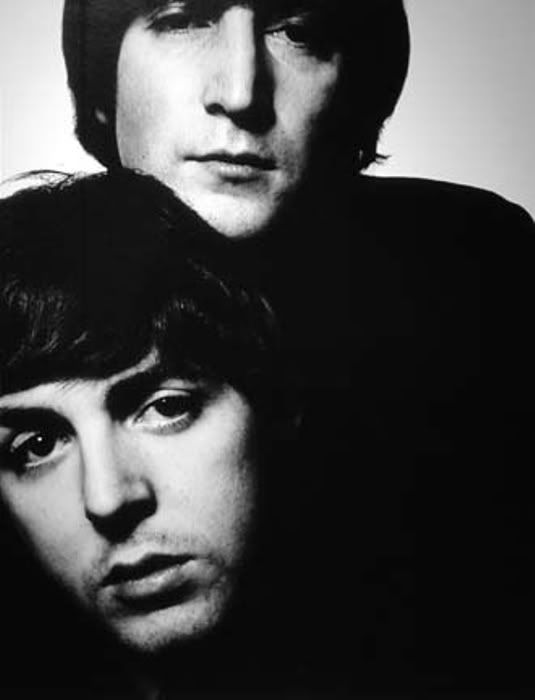
Among the today obscure/forgotten people from the 1965 Pin-Box is for example Gordon Waller (of Peter & Gordon); among the still instantly recognizable one of the most famous pictures ever taken of John Lennon & Paul McCartney. So I knew that one, of course, but what I hadn't known was that Bailey also took portrait shots of Brian Epstein, three of which are included in the exhibition, two regular shots and a double exposure portrait, all excellent. It's worth noting that while the exhibition has several portraits of Jean Shrimpton, there are none from the photo shooting that made Bailey famous in 1962 (maybe Vogue still has the copy right?).
From photography to theatre: after visiting the National Portrait Gallery, I headed off to the other side of the river to see King Lear at the National Theatre, starring Simon Russell Beale in the title role, directed by Sam Mendes. Which was a very strong production, even if I'm still uncertain about some of the choices. Mendes went for a vaguely 1940s - general 20th century look, military dictatorship instead of traditional monarchy; interestingly, the French forces under Cordelia are clad in a brown guerilla look while the English ones both under Lear and later under Albany and Edmund are clad in a fascist black. Beale's Lear, as most good Lears do, starts very unsympathetic and gets more and more human and pitiable as the play proceeds. When he first says "let me not go mad" it's also the first time I felt any sympathy for him. Mind you, the autocratic behaviour in the opening scene of course means Lear comes off badly towards Cordelia and Kent however you play it, but in this production he also came off badly towards Goneril and Regan, with no warmth towards them yet expecting them to love (and proclaim their love for) him, plus the production had the hundred knights really rowdy (and, remember, in sinister black) at Goneril's, so Goneril feeling threatened and wanting to get rid of them in addition to having a strained relationship with her father was understandable. When Lear curses her, you can see how terrible this is for her. And then, like I said, the first human moment: "Let me not go mad". And suddenly Beale is projecting this fear, the moment of awareness, and it's so relatable - the fear of dementia, of Alzheimer's, of your own body and mind betraying you, of the helplessness when everything threatens to be taken away.
This is a production that feels very fast paced, but not in a bad way, as things go from bad to worse in both the Lear and the Gloucester plot; the suspense never snaps. Two outstanding moments in the first half before the interval - Gloucester's blinding, with the servant's intervention given its dramatic due when most productions I've seen tend to get that moment over with very quickly. (I think it's a great touch of Shakespeare's, especially given the "even if the King's cause is wrong, our duty towards him absolves us from any blame" debate in Henry V, because here you have a character who is not a noble going against the rule of duty and obedience because he can't stand seeing a man tortured this way. Also, before the blinding there is waterboarding as Regan and Cornwall interrogate Gloucester. Obvious contemporary nod is obvious. And speaking of Regan and Cornwall, usually because Regan moves on quickly to Edmund and is the less present sister in any case she doesn't get more emotional range beyond sadistic sex kitten; here she's sadistic and enjoying sex, but she's also sincerely in love with her equally cruel husband and devasteted when he's killed, desperately trying to stop the bleeding and save him. (She's also played by Anna Maxwell Martin of Bletchley Circle fame.)
The other outstanding scene, and a production choice I'm not sure about, is the climax of Lear's mad scene just before the interval. In the text, he stages a mad mock trial of his daughters. "Is your name Goneril" etc. In Sam Mendes' production, he doesn't just mistake a stage prop for Goneril, though he starts out with that. No, he then ( does something spoilery and unique to this production ) Then again, madness. I just don't know.
Later Lear also acts kindly towards Edgar-as-Tom, and towards Gloucester, which shows why Cordelia and Kent love this man (which is important; if you play Lear as solely bad, which I've also seen - and Jane Smiley does it in her modern Lear, A Thousand Acres, where he's a daughter rapist to boot - then not only there's no tragedy but it doesn't make sense anyone would feel love and loyalty for such a man). And the reconciliaton scene with Cordelia is outstanding; I have never seen a production where not only there is a Lear reluctant because he's so ashamed at how he treated her but also Cordelia who on the one hand loves and pities him but on the other is scarred by what happened herself, and so there is physical distance and uncomfortableness and slow, slow getting closer, so that when they do at last embrace, it is incredibly moving.
Always a question for actors for Lear: are you on the one hand old enough not to need ghastly make up but on the other strong enough to carry your Cordelia on the stage? Beale is up to the job. I've seen Lears drag their Cordelia because carrying an adult woman in your arms is no mean feat, but he accomplishes it. He's also one of the Lears whose "look there, look there" isn't a comforting final delusion that Cordelia still lives and starts to breathe again,but a despair about her death. It's heartrendering.
I haven't said much about the Gloucester plot, which is partly because it contains another of those choices I'm not sure about. Now this production's Edmund (Sam Troughton - a relation, I wonder?) with his sleeked back blond hair is slick enough in the machinations early on but also presented as a cold fish, which, fair enough, it's just that you have a hard time seeing why Goneril and Regan (both played by charismatic and beautiful actresses conveying much emotion) would fall for him. And in the later half, Mendes cuts Edgar's narration of Gloucester's death (so while on the one hand he adds ( that spoilery thing from the big madness scene ) on the other he lets Gloucester survive), and thus also Edmund's moment of being moved by it and the following not exactly repentance but at least attempt to take his orders for Lear's and Cordelia's deaths back. Also cut is Edmund's possibly vain and/or possibly being moved remark re: Regan's and Goneril's demise, "so Edmund was beloved". In short, those slight touches which don't make Edmund less of a villain but do make him human.
These caveats not withstanding, it is an excellent Lear, and I'm glad to have watched it. Onwards to more London theatre!
I always visit the National Portrait Gallery when I'm in London; it's less crowded than the National Gallery, and it appeals to the historical obsessive in me. This time, as it turned out I could also visit the exhibition showcasing David Bailey's work over the decades, Stardust. There is an undertone of "I didn't just photograph the 60s, you know" there, but then, it's true. Mind you, whether 60s, 80s or 2000 onwards, what's undeniable is that black and white is Bailey's metier; the occasional colour photograph simply isn't as effective. The title not withstanding, the exhibition doesn't solely consist of Bailey's celebrity photos; there is one room with showing his photos of New Guinea people and Australian Aborigines, neither of whom are treated condescendingly or in any different from the way he photographs Western people, and another with his contribution to Live Aid which was to go to Sudan and document the situation there without fee. But inevitably, this being David Bailey, two thirds of the exhibition show people which one does know. (Well, I did, anyway.) Two of the most interesting portraits to me which I hadn't seen before were photos Bailey did of fellow photographers, of Don McCullin (probably most famous for his Vietnam work and in this the antipode of Bailey in terms of subject matter in the 60s) in the 90s, looking craggy and sage and yet somewhat amused, and of Linda McCartney in 1985, the face unabashedly without make-up and showing every line of a woman in her mid forties, and strong in herself for it. Incidentally, in terms of self portraits, Bailey's are a mixture of unflinching sense-of-humor about himself - the more current day ones not only are as unflattering as possible but also tend to have him posing as a clown, all grimaces, puffed up cheeks and nose - and youthful showing off; there is one photo of the young David Bailey lounging in bed which is amazingly sexy and makes it understandably why supposedly two thirds of his models ended up having sex with him.
His favourite band, the Rolling Stones, get their own room (the notes informing us that David Bailey first met Mick Jagger when they were dating the Shrimpton sisters, Jean and Chrissie, in 1963, and that they're friends till this day), but in terms of his older work, the non-Stone photos are more memorable; another part of exhibition shows the "Pin-Box" collection he published in 1965 which had most of Swinging London (some of whom remained famous, and some folk who have since fallen into obscurity) in it, including the most notorious gangsters of the day, the Kray twins. Now I had seen Bailey's portrait shot of Ronnie and Reggie Kray before (and so have you, if you've seen photos of the Krays at all), but what I hadn't been aware of was that he took that photo in session with all three Kray brothers (yes, there was a third). Older brother Charlie was subsequently edited out of all the pictures (the exhibition has the originals, though), since no one cared about him. I sometimes wonder whether it's the awareness of who the Krays were that make me imagine you can see the cold brutality in the eyes, a certain psychopathic blankness, and whether I would read the photographsh differently if they were labeled "Ronald and Reginald Smith". But I think not; Bailey, at his best, can get across much character in his pictures.
Among the today obscure/forgotten people from the 1965 Pin-Box is for example Gordon Waller (of Peter & Gordon); among the still instantly recognizable one of the most famous pictures ever taken of John Lennon & Paul McCartney. So I knew that one, of course, but what I hadn't known was that Bailey also took portrait shots of Brian Epstein, three of which are included in the exhibition, two regular shots and a double exposure portrait, all excellent. It's worth noting that while the exhibition has several portraits of Jean Shrimpton, there are none from the photo shooting that made Bailey famous in 1962 (maybe Vogue still has the copy right?).
From photography to theatre: after visiting the National Portrait Gallery, I headed off to the other side of the river to see King Lear at the National Theatre, starring Simon Russell Beale in the title role, directed by Sam Mendes. Which was a very strong production, even if I'm still uncertain about some of the choices. Mendes went for a vaguely 1940s - general 20th century look, military dictatorship instead of traditional monarchy; interestingly, the French forces under Cordelia are clad in a brown guerilla look while the English ones both under Lear and later under Albany and Edmund are clad in a fascist black. Beale's Lear, as most good Lears do, starts very unsympathetic and gets more and more human and pitiable as the play proceeds. When he first says "let me not go mad" it's also the first time I felt any sympathy for him. Mind you, the autocratic behaviour in the opening scene of course means Lear comes off badly towards Cordelia and Kent however you play it, but in this production he also came off badly towards Goneril and Regan, with no warmth towards them yet expecting them to love (and proclaim their love for) him, plus the production had the hundred knights really rowdy (and, remember, in sinister black) at Goneril's, so Goneril feeling threatened and wanting to get rid of them in addition to having a strained relationship with her father was understandable. When Lear curses her, you can see how terrible this is for her. And then, like I said, the first human moment: "Let me not go mad". And suddenly Beale is projecting this fear, the moment of awareness, and it's so relatable - the fear of dementia, of Alzheimer's, of your own body and mind betraying you, of the helplessness when everything threatens to be taken away.
This is a production that feels very fast paced, but not in a bad way, as things go from bad to worse in both the Lear and the Gloucester plot; the suspense never snaps. Two outstanding moments in the first half before the interval - Gloucester's blinding, with the servant's intervention given its dramatic due when most productions I've seen tend to get that moment over with very quickly. (I think it's a great touch of Shakespeare's, especially given the "even if the King's cause is wrong, our duty towards him absolves us from any blame" debate in Henry V, because here you have a character who is not a noble going against the rule of duty and obedience because he can't stand seeing a man tortured this way. Also, before the blinding there is waterboarding as Regan and Cornwall interrogate Gloucester. Obvious contemporary nod is obvious. And speaking of Regan and Cornwall, usually because Regan moves on quickly to Edmund and is the less present sister in any case she doesn't get more emotional range beyond sadistic sex kitten; here she's sadistic and enjoying sex, but she's also sincerely in love with her equally cruel husband and devasteted when he's killed, desperately trying to stop the bleeding and save him. (She's also played by Anna Maxwell Martin of Bletchley Circle fame.)
The other outstanding scene, and a production choice I'm not sure about, is the climax of Lear's mad scene just before the interval. In the text, he stages a mad mock trial of his daughters. "Is your name Goneril" etc. In Sam Mendes' production, he doesn't just mistake a stage prop for Goneril, though he starts out with that. No, he then ( does something spoilery and unique to this production ) Then again, madness. I just don't know.
Later Lear also acts kindly towards Edgar-as-Tom, and towards Gloucester, which shows why Cordelia and Kent love this man (which is important; if you play Lear as solely bad, which I've also seen - and Jane Smiley does it in her modern Lear, A Thousand Acres, where he's a daughter rapist to boot - then not only there's no tragedy but it doesn't make sense anyone would feel love and loyalty for such a man). And the reconciliaton scene with Cordelia is outstanding; I have never seen a production where not only there is a Lear reluctant because he's so ashamed at how he treated her but also Cordelia who on the one hand loves and pities him but on the other is scarred by what happened herself, and so there is physical distance and uncomfortableness and slow, slow getting closer, so that when they do at last embrace, it is incredibly moving.
Always a question for actors for Lear: are you on the one hand old enough not to need ghastly make up but on the other strong enough to carry your Cordelia on the stage? Beale is up to the job. I've seen Lears drag their Cordelia because carrying an adult woman in your arms is no mean feat, but he accomplishes it. He's also one of the Lears whose "look there, look there" isn't a comforting final delusion that Cordelia still lives and starts to breathe again,but a despair about her death. It's heartrendering.
I haven't said much about the Gloucester plot, which is partly because it contains another of those choices I'm not sure about. Now this production's Edmund (Sam Troughton - a relation, I wonder?) with his sleeked back blond hair is slick enough in the machinations early on but also presented as a cold fish, which, fair enough, it's just that you have a hard time seeing why Goneril and Regan (both played by charismatic and beautiful actresses conveying much emotion) would fall for him. And in the later half, Mendes cuts Edgar's narration of Gloucester's death (so while on the one hand he adds ( that spoilery thing from the big madness scene ) on the other he lets Gloucester survive), and thus also Edmund's moment of being moved by it and the following not exactly repentance but at least attempt to take his orders for Lear's and Cordelia's deaths back. Also cut is Edmund's possibly vain and/or possibly being moved remark re: Regan's and Goneril's demise, "so Edmund was beloved". In short, those slight touches which don't make Edmund less of a villain but do make him human.
These caveats not withstanding, it is an excellent Lear, and I'm glad to have watched it. Onwards to more London theatre!