Expand Cut Tags

No cut tags
selenak: (Default)
My Yuletide recipient has commented, phew. This was a new-to-me person, so unlike the last few years, I had no idea what their reaction would be, and they wrote lovely, detailed feedback. Hooray! Have a few more recs:

A Dangerous Man: Lawrence after Arabia:

Not for this Age by Five: a elegantly written "Five things...." about T.E. Lawrence and Prince (later King) Feisal. (BTW, accessible even if you're unfamiliar with the movie it's invoking, but if you are, remedy that, because it stars a young Ralph Fiennes as Lawrence and a young Siddig el Fadil as Feisal (this was the gig that got him the role of Dr. Bashir on DS9), and they're both superb.

The Expanse:

Fraternization: a Drummer pov on five of her relationships. Excellent.

For All Mankind:

Gimbal Lock In which Margo in s4 tries very hard not to reach conclusions when musing on both Sergei and Irina. Very intense look on Margo's emotional life in the USSR.

Jonathan Strange & Mr. Norrell:

The Stars not seen before: post-book tale featuring in addition to our sort-of-heroes the definitely heroic former Stephen Black; the mixture of social awkwardness, humor and magic is wonderfully evocative.

Watership Down:

Blackavar‘s Apprehension: Blackavar backstory, very plausible and a great take on life in Efrafra.

The Wire:

Fairy Tale of Baltimore: in which Stringer Bell is contemplated and contemplates through the years. Intense and superbly written, worthy of the show.

Willow (TV):

The Wizard King of Galladoorn: since this charming tv show was cruelly canceled, we shall never now how Graydon extricates himself from the situation he ends up in in the s1 finale, and this story doesn't say, either, but it provides a lovely take on the likely aftermath, the character, and the ensemble interaction.
selenak: (Carl Denham by Grayrace)
This was another film which deeply divided my flist into nays and yays..  As it finally was released in Germany yesterday, I watched it myself, and am firmly among the yays. It's an individual reaction. You may not share it.  But let me explain why I loved a great deal of what I saw.

Read more... )
selenak: (Amy by Calapine)
As I won't get to watch the new Fringe until the 21st or thereabouts, have some links collected over the last week referring to other interests instead:

Sherlock and Doctor Who:
A Scandal in Fandom: Stephen Moffat, Irene Adler and the fannish gaze: probably the best post on the matter I've read so far, blessedly unpolemical, and great with putting everything in context. Very good to read both if you've liked A Scandal in Belgravia (which I did), or if it made you add another item on your personal "I hate Moffat" list. I especially appreciate what the essayist points out about the original Irene (in Doyle's story) versus how she lives in the fannish consciousness, because I tend to fall into the trap of misrememberance there as well.


19th century English literature:

Bronte-saurus: one of those posts that make me nodd and say, "me, too". For all that I appreciate Austen, I love the Brontes, and their fantasy role play obsessed childhood.

T.E. Lawrence:

Lawrence' sexuality: the 2012 edition: a post in which the still hotly debated matter of Lawrence's sexuality is written about with far more insight and grace than your avarage biographer manages.


When fandoms collide, Take #4355:

Karen Gillan interview about her upcoming role as model Jean Shrimpton in in We'll Take Manhattan, which by the sounds of it is about David Bailey's (= most famous photographer of Swinging London, young padawans) big breakthrough as a photographer in 1962. Quoth the article:

We'll Take Manhattan is a portrait of a photogenic love affair, but lit with flashes of class anxiety and period misogyny. While Shrimpton is portrayed as a beguiling ingénue, a muse who says little but looks great, Bailey (played by Aneurin Barnard) is the domineering, hostile "artist", who shouts threateningly at women, uses Shrimpton and forgets his wife. I'll say it – Bailey comes off like a bit of a dick, doesn't he?

To which I say: how is this news? Not if you've ever read an interview with David Bailey during the last 50 or so years. (Or watched Blow Up; the photographer in it is famously based on Bailey.) He's sublimely gifted without a doubt, but prone to come up with such charming statements as the one in this interview: People say I seduced a lot of women, which makes me very immature. Well, what does that make the women I seduced? Or boastings like the one in this article:

'I remember Jean Shrimpton,' says Jane. 'She was lovely.'
'I remember her well, dear,' chortles Bailey. 'In every position!'


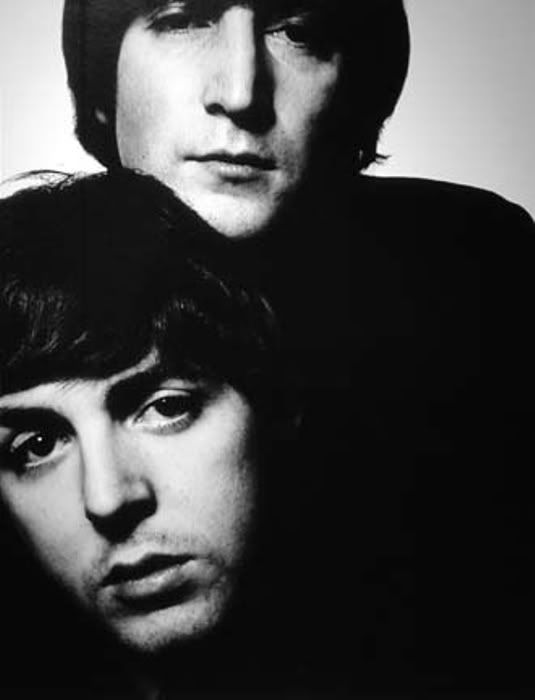
Of course, if like me you're somewhat invested in a certain group from Liverpool, you come across David Bailey also in the context of a legendary 1965 photo session where he only wanted to photograph John Lennon originally as he wasn't interested in the rest of the Beatles (and, rumour has it, was very interested in John indeed), was told John wanted to be photographed with Paul and ended up shooting smouldering-with-something portraits. (The only other time when John did a session with him was with Yoko at his side in 1969. You had it coming, Bailey, you had it coming.)
selenak: (Romans by Kathyh)
I've stopped reviewing Dexter and will stop watching once this season is over, but may I say, apropos the latest ep: 1.) Bad idea, writers/producers. Really bad idea. And 2.) Most unrealistic therapist ever.

On to actual reviews and more enjoyable fandoms. First a vid rec: Virgin is a fantastic evocation of Antony, Vorenus, Rome and Rome.

Then upon reviewing films and plays dealing with characters' lives, how they approach their subjects, and whether or not a satisfying story is the result:

Miss Austen Regrets (Film, 2008) )

The Oxford Roof Climber's Rebellion (Play by Stephen Massicotte about T.E. Lawrence and Robert Graves, 2006) )
selenak: (Borgias by Andrivete)
Yuletide nominations are running until Monday morning. Mine were The Borgias (with characters Lucrezia, Giulia, Vannoza and Rodrigo - I really want a story about Lucrezia and Giulia, but the rest of the clan in supporting roles is welcome as well), 18th Century CE RPF (with characters James Boswell and Mary Bryant because I wish someone would write the story about Boswell's defense of Bryant after her return from Botany Bay, the clash of two utterly different worlds, etc.), and Sharon Penman's novel The Reckoning (with characters Davydd ap Gruffydd, Llewelyn ap Gruffydd, Elizabeth de Ferres and Ellen de Montfort - even though this is the Penman novel which inevitably makes me cry and breaks my heart every time I read it, I would love to read more about the fraternal relationship at the core of it). The Borgias as a fandom were accepted, but we'll see about the others.

I was going back and thro as to whether or not to nominate something T.E. Lawrence related, because I've been browsing through his letters again, but I wanted the other subjects more. Still, Lawrence (as in Lawrence of Arabia): one of the great letter writers of the 20th century, both because he was great with descriptions and because his letters have the gift of feeling like immediate speech, with the tone varying depending on the recepient. (With the most revealing and intimate letters probably written to Charlotte Shaw - wife of G.B.S who became Lawrence's confidant post war - and to novelist E.M. Forster.) And the subjects are great, from vivid and astute pen portraits of many of his contemporaries to books and plays to his life long struggle with his sexuality.

Choice excerpts beneath the cut )
selenak: (a dangerous man by selluinlaer)
Two days ago I watched There Will Be Blood, which is one of those movies you can't bear watching again any time soon but are glad to have watched. It gives you the sense of some monolithic lethal landscape, to be regarded in appalled awe. I've seen comparisons to Citizen Kane, but aside from the fact that both central characters spend the last ten minutes of their respective movies lonely in castles of their own, I can't see a bsis of comparison; two very different animals, those films and those characters. We see Charles Foster Kane from various perspectives, and among many other things, Citizen Kane has rapid-fire dialogue; you can tell that Herman Mankiewiciz, the scriptwriter, comes straight from the Hollywood of the screwball comedy era. Daniel Plainview, the main character of There Will Be Blood, on the other hand, is the viewpoint character of the film, there are probably just three or so scenes he's not in, and if he resembles any epic millionaire in cinema or real life, it's Howard Hughes rather than William Hearst (or Kane). It's a tour de force performance by Daniel Day-Lewis, and it needs to be, because the script takes no prisoners as Daniel Plainview gets more obsessive, crazier and more inhuman by the minute. It's Lear without Lear's reconciliation with Cordelia; a terrible, terrible old man at the end, but you can't look away. (Plainview has a Cordelia, and a Fool, too, but when his adopted son whom he does love has an accident and is deaf as a result, Plainview can't handle it and sends him away; and the man claiming to be his half-brother Henry, his Fool, affectionate in his harmlessness, whom Plainview opens up to a bit, suffers a terrible fate when Plainview feels himself betrayed.)

Plainview gets introduced in fifteen minutes of mostly silent film, and only then do we hear his voice, and you can tell Day-Lewis goes for Shakespearean, too, "I am an Oilman" rolling of his tongue as if it's "I am determined to be a villain". Speaking of silent film, his early scene with the baby that is to become his adopted son has echoes of Chaplin's The Kid which is a truly horrid irony considering how this father-son relationship will end up, and yet strangely appropriate: there is joy and sudden tenderness in both scenes, but Plainview isn't the Tramp, he's the millionaire, and the millionaire might occasionally befriend the tramp but in the end will always turn on him.

If I have a cricitism, it's that the script doesn't make clear whether two crucial characters played by the same actor are meant to be the same person using different names, or two different people; I had to look up the novel the film is vaguely based on, Upton Sinclair's Oil!, to find out they were in fact meant two be brothers. Still, it's just one flaw in the whole larger than life monstrosity which is this film, and the feeling of awe still persists, so I don't mind.


****


A postscript to my Mallorca vacation: on Tuesday, our last day, the sky was still cloudy, so we didn't make the hiking tour we had planned but went back to Deia to visit Robert Graves' house-turned-museum, which had been closed due to an electricity fallout the week before. The house, called Ca'n'Alluny or Canellun (the later name was the one Graves himself used), makes you wistful and doesn't come across as morbidly museal at all but as if he'd left it just five minutes ago.

Photographic proof! )
selenak: (a dangerous man by selluinlaer)
Back in Germany, dead exhausted. In a good way; it was a great week. After working in the British Library, I treated myself to the absolutely gorgeous exhibition there, Sacred, which presents basically the holy books of Judaism, Christianity and Islam through the centuries. Now of course I had seen numerous medieval bibles before - and beautiful they were - and even the occasional Talmud, but never before so many Qu'rans, ranging from editions like the one penned for Sultan Baybar which has just six words written in gold per page to handy Qu'rans made of and written on leather so you could carry them in the saddle bag. The exhibition might as well have been subtitled "people of the book", because that Muslim description of the the other two Abrahamic faiths sums it up for all three there. And no matter whether New Testament, Thora or Qu'ran, standing there, looking at those books that must have taken decades to create, each letter painted so carefully, one felt awed and silenced by both labour and beauty.

On a more chatty note, I had a delightful lunch with [livejournal.com profile] londonkds, and we geeked out afterwards in the sun; this week has been something of a mini convention to me, only with one friend at a time instead of all of them at the same time. But I need to make introductions the next time; living in the same city as they do, they need to meet each other!

My last theatre treat was Saint Joan at the National Theatre, with Anne-Marie Duff in the title role. It's my favourite Shaw play, and so I was both gratified it was sold out (I think I got the last ticket) a few days earlier when I bought it) and somewhat nervous (what will they do with it?). It was performend in the Olivier, where I had seen Sophocles' two Oedipus plays - which was an amazing experience, especially since the Olivier is build somewhat like a Greek amphitheatre - and Macbeth with Derek Jacobi as Macbeth and some noneentity, sadly, as Lady M (it's a curse - other than dream team Ian McKellen/Judi Dench on video, I never ever saw a Macbeth with both M and Lady M played by great actors). They went for minimum scenery (basically just chairs and flags) and a mixture of present day and vaguely historical costume (the inevitable armour for Joan, mainly). Acting-wise, it was good, with one reservation I had about Anne-Marie Duff - as long as Joan was still ascendant and got her way, she was a bit one-note and too high strung for my taste, and I kept wondering where she would go from there, considering what was to follow; but after the interval, from her fallout scene after the coronation at Reims onwards, she was great. The two crucial scenes, which must be fiendishly difficult for an actress - the trial scene in which she finally does recant only to recant her recantation when she sees it will only give her a life time in prison, and the end of the epilogue were incredibly intense. She played Joan's breakdown so painfully real, not quieter and quieter as I had seen it done before but with cries and sobs that really made you believe this was a woman a) who had been imprisoned for months and b) in fear of her life; and yet you also completely believed her when she went from there to "light your fires". The horror of imprisonment, the horror of death in flames; I can't think of another production which pulled that of.

In the program, one of the essays makes the caustic comment that Joan today would wear the red of a Guantanamo prisoner; our Regietheater being that it is, you can bet she would have done in a German production. The Brits didn't go there, presumably trusting the audience to make their own uncomfortable analogies, and thus remained more universal.) Stogumber's breakdown after Joan's burning when faced with the reality of her death as opposed to the bloodthirsty rethoric and Cauchon's question - "does a Christ have to die in every generation for those of too little imagination" rarely have so resonated.

I'm in two minds about what they did with the epilogue; they basically cut it down to the characters in it saying what happened to them post-trial, left the interaction between them and Joan out altogether (until the very final one), along with the English soldier and the visitor from 1920, and gave the announcement of Joan's canonization to Brother Martin. However, from then onwards we did get the rest of the epilogue, and the bit which is the crucial point; everyone praising Joan, Joan's "woe to me if all men praise me" (which Michael Holyrood appropriately observed is very much old GBS talking about himself, too) and offer to return from the dead, everyone turning away in horror at the prospect, and Joan's final question, which was as powerful as in every other version of the play I've seen and heard: "O god that madest this beautiful earth ,when will it be ready to receive Thy saints? How long, o lord, how long?"

The reason why I'm in two minds about the cuts: on the one hand, they didn't take a way the core of the epilogue, so I'm good with it, on the other, they did take away something that's important - to me, at least - about the play, something of its, in lack of a better term, Shavian dimension. The going from the horror of Joan's death to the chit-chat in Charles' dream only gradually turning into the haunting final point is so very GBS; the Shaw version of a tragedy is still wonderfully witty, after all, and to make the epilogue bleak-only is to make it more of a classical play than he ever wanted to write.

Ah well. Otherwise, I was gratified to see the gags worked as reliably as ever, many decades after Shaw wrote them. The big discussion between Warwick and Cauchon, with Stogumber as the occasional third, is pure talk, pure debate, no action, and if it's not one of the most riveting and funny scenes of the play, you're doing something wrong. They got it right. (And I was very amused how many people in the interval which immediately followed that scene referred to Shaw being Irish in their conversation; though maybe they're right, maybe you have to be Irish to make as relentlessly fun of English nationalism (with Stogumber's English patriotism being the comic mirror of Joan's French one) as Shaw does.)

I'm not sure GBS would have approved of them actually showing - well, miming - the burning. It did work for me, but I also remembered the fact that the play doesn't show Joan's death as written was one thing T.E. Lawrence argued, letter-wise, with Charlotte Shaw and thus by proxy with GBS about. Lawrence was friends with the Shaws at that point and Holyrood argues, not implausibly, that Shaw used some of his characteristics for Joan. He got sent an advance manuscript of the play and loved it. After praising it to the skies, he came to his one cricticism, which was: "It was good to make her sign that confession... and then she died, 'off'. I have a prejudice against the writer who leaves the reader to make his top-scene for him. I funked it, in the deaht of Farraj, faced it, in the plain narrative of my mishaps in Deraa the night I was captured. Here in St. Joan the climax will be the red light shining from the courtyard. It's indirect art and direct shirking. Of course if he'd dipped his pen in all his strenght and written straight forward the play could never have been presented: but the more honour so. I twould have cleaned us all to have seen Joan die."

(Charlotte Shaw wrote back, not surprisingly disagreeing, and got in return an autobiographical confession: "The trial scene in Joan. Poor Joan, I was thinking of her as a person, not as a moral lesson. The pain meant more to her than the example. You instance my night in Deraa. Well, I'm always afraid of being hurt: and to me, while I live, the force of that night will lie in the agony which broke me, and made me surrender. It's the individual view. You can't share it. About that night. I shouldn't tell you, because decent men don't talk about such things. I wanted to put it plain in the book, and wrestled for days wiht my self-respect... which wouldn't, hasn't, let me. For fear of being hurt, or rather to earn five minutes respite from a pain which drove me mad, I vae away the only possession we are born into the world with - our bodily integrity. It's an unforgivable matter, an irrrecoverable position; and it's that which has made me forswear decent living. You may call this mordbid: but think of the offence, and the intensity of my brooding over it for these years. It will hang about me while I live, and afterwards if our personality survives. Consider wandering among the decent ghosts hereafter, crying, 'Unclean, unclean!'" The sting of the burning was very big in Joan and GBS would have made his play impossible by portraying it.. Yet if the play was to be not a morality but life itself, he would have given the physical its place above the moral." )

Today was travel back day; and for the first time since last I was in the US, I had to remove my shoes again. Note to self: be grateful you wore socks. I wouldn't want to go barefeet on that ground at Heahtrow...
selenak: (a dangerous man by selluinlaer)
Lawrence of Arabia and A Dangerous Man are two quite different films in form and intention - a cinematic epic versus an intimate political tv drama (what we'd call Kammerspiel in German); both feature excellent actors and clever scripts, and obviously, both are based on different parts of that much debated and enigmatic man, T.E. Lawrence. I wouldn't have thought it possible to make a vid based on both, would have guessed the different sources too jarring (Peter O'Toole obviously not being Ralph Fiennes, Alec Guinness not Siddig el Fadil - that's Alexander Siddig for DS9 latecomers - etc.), but no: here's a wonderful visual meditation on Lawrence using both films.


Dreamer of the Day

Profile

selenak: (Default)
selenak

August 2026

S M T W T F S
      1
2345678
9101112131415
161718 192021 22
23242526272829
3031     

Most Popular Tags

Syndicate

RSS Atom

Style Credit

Page generated Aug. 25th, 2026 06:30 am
Powered by Dreamwidth Studios