Expand Cut Tags

No cut tags
selenak: (Livia by Pixelbee)
The awesome Helen Mirren turns 80 today. Long may she continue to rule and remain with us! I think the first thing I remember watching with her that made me sit up and pay attention was her as D.I. Jane Tennison, but since then she's never disappointed in any role I've seen her in, both before and after Tennison. I have a particular soft spot for her Elizabeth II and Alma Reville, I must confess. Most recently I took up someone's dare and watched "Caligula - The Ultimate Cut". Caligula, if you don't know: Became (in)famous as basically a late 1970s porn movie with famous actors (among others Peter O'Toole as Tiberius, John Guilgud as Nerva, Malcolm McDowell in the title role, Helen Mirren as Caesonia, Caligula's last wife) due to the fact that even for a 1970s movie, it had a crazy production history: first the scriptwriter - none other than Gore Vidal - and the director, Tito Brassi, fell out and Vidal withdrew his name from the script, then the director and the producer fell out, and since the producer was the then owner of Penthouse, he went back to the set with some Penthouse girls, shot some hardcore porn and inserted into the already shot footage. The example most quoted for how this worked was that where the scene had a non-explicit threesome between Caligula, his sister Drusilla and Caesonia, the released version added two other women spying on them and having very explicit hardcore f/f sex while doing so. This caused the director to withdraw his name as well and the actors making somewhat embarrassed quips for the next few decades (other than MacDowell, who was seriously pissed off about the then result, and Mirren, who was debonair about it and called it "an irresistable mixture of art and genitals"). Then in 2024, a dedicated film fan named Thomas Negovan released the result of some serious work - he'd gotten access to all the shot footage, and recut the entire movie, going back to Vidal's script and using exclusively takes not used for the late 1970s release (and none at all from the porn additions, not that the actual movie is without sex scenes, au contraire), with the result that a pleased McDowell praised him for rescueing "one of my best performances" from cinematic oblivion. Reviews I had read did concede that now there is an actual storyline and (some) character development. (A scene in question singled out and compared/contrasted: apparantly, the original cinematic release version had Caligula simply shouting crazily "crawl, crawl!" at the senators, who did it. The Ultimate Cut version, by contrast, has this scene near the end, with some overtones of Camus as Caligula has long gone from delight to disgust at how no matter what he does, people will obey and abase themselves, and the longer version of this scene has him asking for increasingly outrageous things, cultimating in the "crawl, crawl" and the declaration he hates them for being like that. (Mind you, earlier in the movie when one brave young man did stand up for himself, this resulted in Caligula interrupting the guy's wedding night to rape him and his bride both.)

In case you're wondering whether the result is worth watching: depends. Certainly as opposed to, say, I, Claudius' Caligula (and his avatar in Babylon 5, Cartagia), who are evil from the get go - in the case of Graves' Caligula literally from birth, he's already a creepy kid when his parents are stil alive - the Ultimate Cut's Caligula has some humanity in him and the introduction sequence makes a point of providing the audience with the backstory of his father Germanicus dying (in this version definitely courtesy of Tiberius), then Agrippina the Elder and Caligula's older brothers all at Tiberius' orders (unlike the death of Germanicus, this is not disputed), with Caligula and his sister Drusilla as the sole survivors (because in this movie, Caligula's other sisters don't exist, though I'm told the porn version actually identifies one of the women having the hardcore f/f as Agrippina, but as the on screen dialogue makes much of Drusilla and Caligula being the sole survivors, I assume in the porn version's Agrippina the Younger would not have been Caligula's and Drusilla's sister), and their incestuous relationship actually one of the very few human, non-abusive and tender relationships happening in the entire movie, with Caligula having the not unreasonable under the circumstances belief that he needs to be Emperor or he's toast as well, only for absolute power to bring out increasingly the absolute worst in him. Buuuuuuuut this existing personal development does not correspond with a general development, by which I mean that since the movie after the introduction with its tragic backstory for young Caligula and the introduction in which he and Drusilla are in a "we two against the world" mode as each other's sole sources of human affection goes on to present Tiberius' life in Capri as a non-stop orgy already, there's no sense that Rome itself pre Caligula is much different than Rome ruled by Caligula. (Incidentally, about the orgy there and the later orgies, which I assume were shot by the original director, since they're certainly rating M or 18, so to speak, but don't have the actors with dialogue do something more explicit than touch someone's nipples, they're the opposite of tiltillating in that no one gives the impression of actually enjoying themselves as opposed to acting on first Tiberius' and later Caligula's orders. The sole exceptions being the scenes involving Caligula, Drusilla and Caesonia.) The Capri sequence does have a moment that gets across human emotion, which is the Nerva scene they hired Guilgud for: this Nerva isn't the later Emperor; he's an old friend of Tiberius who tells his former pal he can't bear the degredation his once friend has sunk to anymore and commits suicide, and Tiberius' reaction to this is when O'Toole actually gets to do some non-hamming-it-up acting. But mostly it numbs you down in its viciousness and it pretty much sets the tone for the film.

Some of the violence is outré and camp, such as the machine decapitating people in the arena who are buried up to their necks in sand, and thus hard to take seriously; otoh the whole Caligula first menaces and then rapes the young couple sequence is violence of a very different type, and genuinely frightening. Drusilla and Caesonia are the two outstanding female roles (and the sole women with personalities); it's another interesting contrast to the I, Claudius versions, in that Drusilla there was a none-too-bright but not personally malicious ditz, whereas here she's depicted as not without her own ruthlessness (she talks Caligula into getting rid of Macro, for example), but also smart and (within this movieverse) sensible, and later the sole person with the courage to argue with Caligula; it's her death (by illness) that removes whatever restraint he has left. Caesonia, too, is depicted as a smart woman (described in dialogue as profligate, but we don't see her having sex with anyone other than Caligula, and in the one threesome scene with Drusilla); Mirren gets hardly any lines in the first half of the movie when Drusilla is still alive but conveys a lot with facial acting, and then in the second half (when she is the character he has most dialogues with) basically becomes the sole person a) aware why Caligula is actually doing all of this ("Do you have to show them your contempt so openly?" "I don't know how else to provoke them"), and b) who among the various sycophants around them still has it in them to be dangerous. As opposed to Drusilla, she doesn't argue with Caligula directly, but she is great at keeping the balance between presenting her critique in a playfull manner and challenging him but withdrawing the moment she senses it could go against her and distracting any ire to another target while returning to her subject in a different way. It's a good role for a young Helen Mirren; this Caesonia is neither a good person nor an evil overlady but a cunning survivor (right until she gets murdered directly after Caligula, that is).

Around these interesting character depictions, however, is, as mentioned above, non-stop viciousness (some sexual, some not) to a degree that it just numbs you down emotionally. In a word: Grimdark. I've said elsewhere that the reason why I, Claudius works in a way many of its imitations didn't is that I, Claudius doesn't just consist of its spectacular villains (be they Livia or Caligula, the two main antagonists, or Sejanus), but offers a sympathetic main character and some other non-evil supporting characters you actually care about, so that when bad things happen to them, you feel for them. None of the various victims and/or targets in Caligula gets enough personality to make it to memorable human being, with the arguable exceptions of Nerva (in the Tiberius sequence) and of the young couple whom Caligula rapes for no other reason that the bridegroom pissed him off by standing up for himself. Drusilla and Caesonia, as mentioned, are interesting and Caligula himself certainly is a charismatic performance by McDowell, who manages to get across Caligula's inner scared child who never grew up along with the increasingly destructive and self destructive nihilism as he figures out that "I can do whatever I want" is neither safe nor as satisfying as he'd assumed but essentially empty. It's now discernable why so many good actors actually signed on to this project (beyond the cash they got). But I wouldn't say their (good) performances are enough reason to put yourself through nearly three numbing hours of grimdark. (Sorry, Thomas Negovan.)
selenak: (Empire - Foundation)
[personal profile] redfiona99 asked me: how would you feel about a Roman AU for Babylon 5? (I quite like the idea of circa fall of the Republic but ...

This got my imagination going, but not to the fall of the Republic; it went to either the Third Century Crisis or later the Attila the Hun era instead, or maybe Justinian. Either way, it's tricky whom to cast the Minbari as, since they are canonically the most powerful of the space faring "younger" races - as Londo says, even at the height of the Centauri Empire, they left the Minbari alone - but there has to be something more powerful standing in for the Shadows and Vorlons, while the Centauri need to be still powerful enough to re-conquer the Narn with Shadow aid.

Preliminarily, I'm going with....

Minbari: Persians (The Sassanian Empire, to be precise)

Humans: Arabs

Centauri: Romans (naturally, but depending on whether we're talking Third Century or Fifth Century or Sixth Centauri, the location of Centauri Prime can be Rome in the first case and Constantinople in the other two)

Narn: Goths

Shadows: Attila the Hun

Vorlons: ???? (If you want to be mean, you can say Christianity)

I could also see the Humans as Franks (equally an up and coming power). Howver: the Minbari really need to be the Persians no matter which century you set the story in in a Roman AU because the Persians (or Parthians) for a thousand years were the one Empire the Romans, even at the height of their power, were forced to see at least as equals. The Romans and the Persians never managed to conquer each other, and it's highly symbolic that after a thousand years (Delenn's favourite time span) of duking it out or being in cold war, you have first one and then the other near victorious and then the newly islamized Arabs steamroll over both in the 7th century. (Well nearly steamroll over both, they didn't get Constantinople, and the Byzantines managed to regroup after a century, reconquer big parts and hang on for some centuries more.) Which is why my AU couldn't be later than the sixth century. And if the Minbari are the Persians, you have the problem that the Franks are far, far away and have no direct conflict with them, whereas the various Arab kingdoms, usually client kingdoms of the Romans when the Empire was powerful and in its decline getting more and more independence, did have conflicts with the Persians.


Babylon 5 itself is a problem. I'm tempted to go with Alexandria as THE multicultural city of antiquity and keeping that distinction well after it had no more politicial power, but it's a bit tricky to justify why the Goths should send a representative there. Well, maybe Theoderich really wanted good doctors and illegal copies from the great Library?


Anyway, I could see Sinclair and Sheridan as being (nominally) Roman governors of Egypt in present time who used to fight for their Arab kingdom of origin against the Persians in the past. Londo is a Roman (either Roman Roman or Byzantine Roman) at the start of the story aware of the utter pointlessness of his Senator position and the decline of Roman power and wishing for the past who gets sold on the idea that allying with these new barbarians, the Huns, is just the ticket to get the Empire back to full strength, and of course finds out how horribly mistaken he is, but in fact he's following tried and true later Roman policy of trying to play one nomadic warrior nation against the other. (Later, when he tries to fix what he's done, he has overtones of Aetius "The Last Roman".) The Narn/Goths are first exposed to the Huns (hence them ending up in Northern Italy and Spain to begin with), which is why Goth!G'Kar is an early warner who doesn't get listened to.

Delenn is a direct descendant of Aradashir I. i.e. a member of the Sassanid royal family, and a Zoroastrian, of course. She is on the track to becoming Queen of Queens but declines in favour of "pursueing her studies at Alexandria" while maintaining all sorts of important political connections to Persian generals and heads of influential families. This has long term consequences. (I could also see Delenn as Pulcheria, with Sheridan as Marcian, but then she's Roman, not Minbari.)
Pulcheria, but then she's not Minbari

Arab!Sheridan's breaking point when he declares independence: if it's the Third Century Crisis, can be at any point when the various Roman Emperors assassinate each other in dizzying speed. If it's the Fifth or Sixth Century, when it looks like the Huns could take over the entire Roman Empire, full stop. And then the Archbishop of Alexandria or Justinian himself wants him to kill all the heretics, at which point Arab!Sheridan breaks with the Church as well.

By the end of the story, the Huns are gone, but what was the Roman Empire has been irrevocably transformed, and many new kingdoms arisen. It is a new age, etc.


The other days
selenak: (Livia by Pixelbee)
As [personal profile] cahn, who asked me this, guessed, said show would definitely be inspired/partially based on Lion Feuchtwanger's trilogy of novels about the Jewish historian Flavius Josephus/Joseph ben Matthias. But not exclusively, not least because there are aspects of the Flavian era which don't show up (Pompeii, for starters), got downplayed (Vespasian's life partner, the freedwoman Caenis, who used to be the slave of Antonia, the daughter of Mark Antony and mother of (I ,) Claudius, does show up in the first novel, but you could do far more with her than Feuchtwanger does), or are hardly mentioned (for example, an adolescent trauma each for Titus and Domitian respectively; Titus was childhood or teenage friends with Claudius' son Britannicus and was in fact present and supposedly co-poisoned at the dinner where Nero poisoned Britannicus and made everyone continue eating, and Domitian was present and in Rome in the year of the four Emperors, as opposed to his father and brother who were in Judaea and Egypt, and barely escaped with his life when Vitellius was Emperor, as opposed to his uncle, Vespasian's brother Titus Sabienus, who led the "Vespasian for Emperor" campaign in Rome).

Still, Joseph(us) is an ideal main character for a show covering the time between the last Nero years, when the Julio-Claudian dynasty ends and after that violent interludium of year the Flavian one starts, and the death of Domitian. He's an interesting person in his own right, he's a historian and thus with a good excuse to either be present or research about most of the key events in these years, though the opposite of an easy hero (extremely simplified, because of the "from resistance fighter to collaborator" development), and because his pov is that of basically three different worlds - the Jewish one, the Hellenistic one and the Roman one - often in great opposition to each other which he tries to bridge and yet is also at odds with - , you get a very different kind of story as if you either just go for the ruling family soap opera, or do what Lindsey Davies did with her highly entertaining Falco series, i.e. fictional mysteries set during Vespasian's reign with a deliberate parody of the noir template, in which our detective hero and his beloved are on the trail of villainy first in Rome and Britain and then all over the Roman Empire. (While fictional Falco hails from a plebeian family, he's still a Roman from Rome - just at a time where "born in Rome" slowly but surely stops being a criteria for "being a Roman", no less.) (BTW: I would love a film series based on the Falco novels as well, of course.) Joseph is both an outsider who experiences the human cost of Empire first hand, and an insider has a close up and personal view on the Flavians, and through him, you can connect storylines of a great variety of people who otherwise are hardly going to encounter each other.

Other tv series friendly elements offered by the Flavians:

- Game of Thrones happens literally in the first seaon as the Flavians come to power in the year of the Four Emperors, and since Vespasian was the Dark Horse candidate (Joseph(us) made a gamble there when declaring him ther Messiah the next Emperor after being captured), you can milk a lot of suspense out of that (especially if teen Domitian in Rome gets his own subplot)

- These are the guys who build the Colloseum (i.e the "Flavian Theatre"), to give it its official name) and inaugurate it in a 200 something days of games marathon, so Gladiator obsessives will get their part of choreographed violence

- Vespasian dies a natural death in old age, Titus dies of a sickness, but not least due to a lot of ancient writers hating his little brother's guts, you have enough of them side-eying Domitian to justify a murder mystery plot if you want to do one; Domitian definitely was assassinated, so you can go all Ides of March and do a tense conspiracy story there

- interesting women! Caenis I already mentioned, Berenice the Jewish princess whose affair with Titus is so open to a gazillion interpretations (politics? actual love? mutual benefits? all of the above?) and who is someone I've yet to encounter a fictional counterpart off that really satisfies me (the first of Feuchtwanger's Josephus novels comes closest, but then alas there's the second one where he doesn't handle her as well), Domitia Longina (who in Feuchtwanger's novels is called Lucia), the wife of Domitian and supposedly the only person never afraid of him, despite a temporary exile after an affair she had with an actor (Domtiian couldn't live without her and called her back)

- incest! Domitian supposedly had an affair with Titus' daughter Julia after refusing to marry her while Titus according to master of sensationalistic gossip Suetonius could have had a fling with Domitian's wife near the end of his (i.e. Titus') life

- competence! Here you have that oddity, a whole dynasty (since Domitian was the last Flavian on the throne) where not a single member was actually born into the purple amd were actually working Emperors; Vespasian had to clean up the whole mess left behind by Nero and the three short lived Emperors in between and stablize the Roman Empire again, Titus was essentially co-Emperor already during Vespasian's time and in his own short rule had to cope with three natural disasters in a row, including Pompeii, and Domitian may have been a creepy tyrant, but he was a competent creepy tyrant who pushed through the biggest building programm since decades (not just in Rome itself, either) and managed a balanced economy for most of his reign

- doomed rebellions and heartbreaking sieges (in Judea, of course) (I mean, Masada got its own extra tv series already) (with a final successful conspiracy when Domitian gets killed)

- some of the best known ancient writers in addition to Josephus are around (Suetoniius, Martial, Tacitus, Pliny the older and Pliny the younger), and "how to be a writer in a dictatorship" is an eternally challenging question


All of which offers enough material for five seasons at least, especially in this day and age when seasons are no longer 22 episodes long but only eight or six per season. I think old age make up should be up to aging everyone through the years (especially Josephus, who will be around the entire time), though if we do flashbacks to teenage Titus during the murder of equally teenage Britannicus, there needs to be an actual young actor, and Domitian in s1 should look young enough that it's clear he is still in his teens then, so possibly also another young actor than main Domitian who needs to be around till the end as well. Caenis can be a great role for a middle-aged or older actress, and very refreshingly, Berenice is canonically older than Titus when they meet, so no actress in her early 20s/ actor in his 40s or older pairing here. Depending on how much the series draws on Feuchtwanger, controvery is guaranteed, because a great deal of the Josephus trilogy ponders what it means to be Jewish and whether that meaning can change (or not) in the diaspora, and whether or not revolting against a greater military power whom you know will respond with devastating force can be justified. But that's what makes the books so captivating and if the writing of the show is up for it, it might be the same.

Expensive: very, given that not only do you need to show ancient Rome but also ancient Judea and ancient Alexandria in Egypt, and depending on how much you want to include events there, ancient Britain and ancient Germania. Otoh, I, Claudius solved the problem of a small budget by having everyone in costume but no sweeping landscape shots whatsoever (or battles, or gladiator fight scenes - we see what's going on from the reactions of the main characters who are among the audience whenever something takes place during the games), and GCI can do so much these days; it should be workeable.

Fan favourites: party, this depends on the actors. You need a really good one for Joseph(us), and if he's also handsome, I think early fandom will pair him with Titus (and again, depending on how much Feuchtwanger the show includes, definitely with his frenemy and rival Justus of Tiberia), but I'm pretty sure he'll never be the favourite, and will frequently be the cause of long rants early on, though later will secure a kind of "no one's first but many people's second or third favourite" fondness. Teen and young Domitian might get a lot of woobie sympathy if people consider him ill done by because Dad and Big Bro don't take him that seriously and are such a working team that they exclude him, but I don't think that will survive once he actually gets into power, because even if the show goes all revisionist on Domitian he's still going to do a lot of less than palpable things in a slow, methodical way instead of flamboyant craziness. At the latest when he's ordering the first Vestal in over a century to be killed for having had sex in the traditional gruesome way, he'll be out of favour. I'm betting on his wife as an overall favourite, because fearless ladies who have a sex life they themselves choose and don't end up dead or (permanently) exiled, have the All Powerful guy of the show be often putty in their hands and who are alive and well at the end of the story deserve to be.

The other days
selenak: (Default)
A first few Yuletide recs:


Agatha All Along:

Smart and Powerful: in which Jen encounters Agatha for the first time in the early 20th century. Banter, UST and foiled murderous intentions ensue.


Dune:

Adam's Rib: in which Irulan attempts to interview Paul for her histories between Dune and Dune Messiah. (It works for the Villeneuve movies as well until we get the third one, at least.) Very plausible take on these two and what they do and don't share, having grown up as the first born of great houses with Bene Gesserit training.


The Godfather:

Valediction: Tom Hagen and Connie Corleone after Sonny's death.


Macbeth:

The Future in the Instant: Lady Macbeth makes a choice, which involves talking to her husband at a key point of the narrative.


North and South:

Plum Pudding & Clustered Grapes: Margeret wants to host a Christmas dinner for the workers. No one else thinks this is a good idea...


The Odyssey:

The Hekubiad: In which Hecuba did make it to Ithaka post Troy, and provides us with her own pov on ensuing events.

Roma Sub Rosa Series - Steven Saylor

Sub Rosa: Saylor's take on Lucius Sergius Catilina was for me one of the most captivating elements of the book series, and this short story captures a lot of why, as we get a glimpse on Catilina and Meto shortly before the final battle.
selenak: (Livia by Pixelbee)
A few things which didn't do it for me:

James Wilson: The Dark Clue. A decades old novel which got translated into German only now, hence my coming across is accidentally. I did like the premise; it's the execution that sucks. The idea: Marian Halcombe and Walter Hartright from The Woman in White by Wilkie Collins start investigating the life of late legendary painter J.W.M. Turner (as he's referred to in the English speaking world, I was recently reminded, in Germany we refer to him as William Turner) when Walter (himself a painter, lest we forget that detail from TWIW) gets tasked with writing Turner's biography in competition to the guy who in real life did so. I was intrigued and charmed by the idea and suspected Wilson might have started out wanting to write a regular old biographical novel about Turner, then found it tricky because it's hard to get a traditional story arc out of his life, and decided on this charmingly 19th century framing device of two interlocking stories. Now I am a fan of (several of) Wilkie Collins' books and was both fascinated and disturbed by Mike Leigh's 2014 movie about Turner, so I was definitely in the market as the target audience for this book. Alas. The Turner parts of the book are sort of okay - our heroes get contradictory testimony about him reflecting various sides of his character, and there's even the sense of him as essentially a Georgian (time of his youth, when his character was formed) in the Victorian era. But the Wilkie Collins fanfic part of it is just plain terrible. Researching Turner works as an emotional catalyst of sorts for both Walter and Marian. Beware of bad fanfic spoilers. ) In conclusion, a depressing waste of what could have been a clever and intriguing premise.


Domina (TV Series, Season 1): The Julio-Claudian one where Livia is the heroine. I definitely was in the market for this one, and it did provide a lot of things I liked and/or had missed in earlier takes. So we do get very young Livia's life on the run in the post Caesar's death/ pre her (first) husband making his peace with Octavian part of her life, and indeed lots and lots of emphasis on her Claudian background and the fact her father was Team Conspirators. (Speaking of Octavian/Augustus, the show decides to deal with the various changes his name goes through in rl during those years by letting everyone refer to and address him by his first name of Gaius. Fair enough, and makes life easier for tv watchers.) This is also the first tv take that uses Scribonia (aka Octavian's wife before Livia and the mother of his sole surviving cihild, Julia). And while we don't get all of the children Octavia was the mother or in charge of, we do get far more than usual (one of the two Marcellas, both Antonias, Marcellus, and Julus, Antony's surviving (well, surviving into adulthood) son by Fulvia. Still missing in this version: Cleopatra's three kids with Antony.) And just when I was about to complain that Livia's bff/slave/freedwoman is depicted only in relationship to her, even when traumatic stuff happens, the character got her own scenes and responses. I was also amused by the take on Octavian/Augustus rise and consilidation of power as essentially a Mafia story, which, yes, can see that. Though it severely undersells quite how bloody and chaotic things had been with the Republic for the entire century before young O made his moves, which leads into my complaints re: Livia's motivations, more in a second, but what I want to say here is that the appeal of Augustus and the Principate to contemporaries and thereafter wasn't just that he emerged on top after a few bloody years and thus put an end to (civil) war, but that he managed to stabilize a state which simply had not been working anymore and had gone from bloody crisis/war to bloody crisis ever since the Senate decided murdering Tiberius Gracchus was a good way to deal with his call for direly needed reforms.

Why is this important as to why I'm not a fan of the show? Because Domina is yet another case of a sympathetic main character's secret key motivation being the wish to reintroduce the Republic. Because, see, the whole reason why Livia Drusilla (in this version) masterminds the invention of the Principate - makes her second husband from a gangster into a ruler/tyrant, as one character puts it in the show - is that her plan is that one of her sons inherits this complete power from him, and then restores the Republic for real.

Head. Desk. Now, Livia, being the daughter of an actual Republican, is actually at least a more plausible candidate for this than, say, the centuries later Emperor Marcus Aurelius in a way, and she's just a teenager when Caesar dies, so wasn't old enough to have memories of the actual Republic pre-first Triumvirate and could believe it would have been fine if not for Caesar's rise for power. But if this show wants to have its cake and eat it by providing Livia with this noble motivation justifying her increasingly ruthless strategems, while simultanously insisting on her intelligence and refusing to let her to anything to actually set up a transition of power back to the Senate. (Which "restoring the Republic" would have to mean.) On the contrary. Whenever Senators show up, they're scheming to kill Augustus and/or Livia and her kids and mean and temporary obstacles to be defeated, except for Livia's father's old bff who is noble, but doesn't anything mundane like trying to assemble a faction. So how does the show's Livia imagine things would go if all her plans succeed and one of her boys upon being handed complete power nobly hands it back to the Senate? Would the Senate, after decades of being either evil schemers or sycophantic yes-men to Augustus, then suddenly reveal they're really all virtuous statesmen inside? You'd think she'd cultivate at least a few Senators with the potential of being future administrators, especially since if there's no more Princeps inter Pares, that means Rome has to be governed by two different Consuls each other again, and where are they supposed to come from? But no. Meaning: you have a series which on the one hand aims for a "gritty Mafia drama in togas" vibe, a morally ambigous heroine who starts out well intentioned but has to be not just smarter but more ruthless to remain on top once she's there, but on the other you give her this illogical central motivation that only works in a fairy tale world.

There's another structual problem. For Livia to have impressive struggles to achieve, she needs opponents who challenge her. Now, until she marries Gaius, this works well enough, especially since the show presents her first husband (hitherto described as a conservative nice guy in what few fictions he made it into) as an opportunistic, incompetent and increasingly evil louse. But once she's Mrs. Princeps, she's in theory on top of her world. The show gains some tension from the fact that Gaius-as-Augustus has of course no intention of giving up power and that he's smart enough to figure out one day why Livia really married him, but most of the outward menace/scheming Livia has to contend with is brought by either the aforementioned evil senators.... or Scribonia. As in, Livia's predecessor, Julia's mother, carrying an immortal grudge against Livia for being the cause of Gaius divorcing her. (Supporting Scribonia, though not with evil schemes, is Octavia, who in the first two eps actually comes across as the smarter of the two, but after the show goes through a time jump and change of cast so the kids can be nearly grown up teenagers is suddenly naive and gullible as opposed to scheming Scribonia) Scribonia, character wise, is something of a blank slate - I think basically the only things we know about her from the sources is who she was married to (like many a Roman aristocrat, she was so repeatedly, and indeed remarried after being divorced by Octavian), the scandalous way Octavian divorced her, and that when her daughter Julia eventually gets exiled by her father, Scribonia chooses to go with her. (According to Seneca, she outlived her daughter, but it's also possible she died with her at the start of Tiberius' reign.) So sure, you can write her as benevolent or malvolent as you like. But either way - she has zero political power. She is NOT married to the first man of Rome. So the series by shoving her into the female villain position hitherto occupied by Livia in I, Claudius on the one hand wants us to believe in Scribonia as Livia's Enemy No.1, but otoh doesn't justify why Livia doesn't simply get rid of her one way or the other. And then there's the fact the show's Scribonia is none too bright in her scheming. And it's not like Gaius was in love with her and thus would have a reason to keep her around in Rome. (He divorces her as cold-bloodedly on the show as he did in rl, i.e. basically the moment Julia is born and isn't a boy.) So why the show' s Scribonia is in Rome in a position to make trouble instead of being exiled or dead in the last half of the first season makes no sense.

Making this show yet another example of one that learned all the wrong lessons from I, Claudius. I.e. adopt the "but he/she really wants to restore the Republic and is just faking harmlessness" gimmick, but ignore the fact that I, Claudius lets its villains be formidable - Livia herself first and foremost, of course; in that show, she's ruthless and a non-stop schemer, but she's smart and brilliant about it. That's what makes her so chilling. I somehow suspect the original pitch for Domina must have been along the lines of " I, Claudius, but Livia is the heroine, and also, they curse as much as in Rome" and then too late they realized if Livia is the heroine, you need another villain or villains, and landed on Scribonia because someone has to be the evil woman, clearly. Without bothering to think things through.

And then there's the minor irritation of Livia except for the last three episodes wearing her hair open instead of bothering with a Roman hairstyle (though all the other female characters have one). Why? But that's really just one minor detail.

In conclusion: oh producers of historical drama set in the many centuries of Roman Imperial history: you can actually do dramas where the main character does NOT want to restore the Republic.
selenak: (Pompeii by Imbrilin)
All in all: enjoyable on the same level Spartacus the tv show was, i.e. unabashedly trashy yet wish some surprisingly engaging character development. Given Roland Emmerich is responsible for one of my least favourite historical or "historical" movies, "The Patriot" and also for the Oxfordian eloge Anyonymous which I haven't watched, I liked this far better than I expected. My main reason for watching was that it's set in the Flavian era, which hasn't been cinematically and tv wise milked to death yet, and I had recently reread my definitely favourite work of Lion Feuchtwanger, the Josephus trilogy. BTW, I gather there's a book of the same title - i.e. "Those about to die" - which serves as inspiration but not isn't a historical novel but a non-fiction work covering the entire development from funeral games in ye early republic to elaborate mass productions throughout much of the Empire. As I haven't read said book, I only base this assumption on wikipedia and can't say whether it's any good, and can't compare or contrast, either.

On to the gloriously trashy saga )

In conclusion: not a must, but if you liked Spartacus (the tv show) back in the day, you'll probably like this one, too. Oh, and if you've read Lindsey Davis' mystery series starring Marcus Didius Falco and want some visuals, you could do worse.

Hang on...

Jul. 9th, 2024 06:25 pm
selenak: (Porthos by Chatona)
Me, watching the trailer to Gladiator II:

- okay, so more or less fictional son of Lucilla is the hero this time, taking fictional Maximus as his role model, go figure

- at least no one wants Rome to be a Republic again this time around? Instead, the master plan is "make the Empire fall", and since Commodus since Gibbon often works as the start of the Decline and Fall, kinda works, except that the Empire still has a few centuries more to go, and even a millennium, if you count Byzantium, which you should, but aren't we doing Septimius Severus at all?

- hang on, who ware these two Joffrey Baratheon wannabes? Are they meant to be Caracalla and Geta? Where's Julia Domna then? And her sister and nieces? and also, why are they blond and white?

Historical spoilers for the Severan dynasty and the fates of who members of same showing up in the trailer ensue )

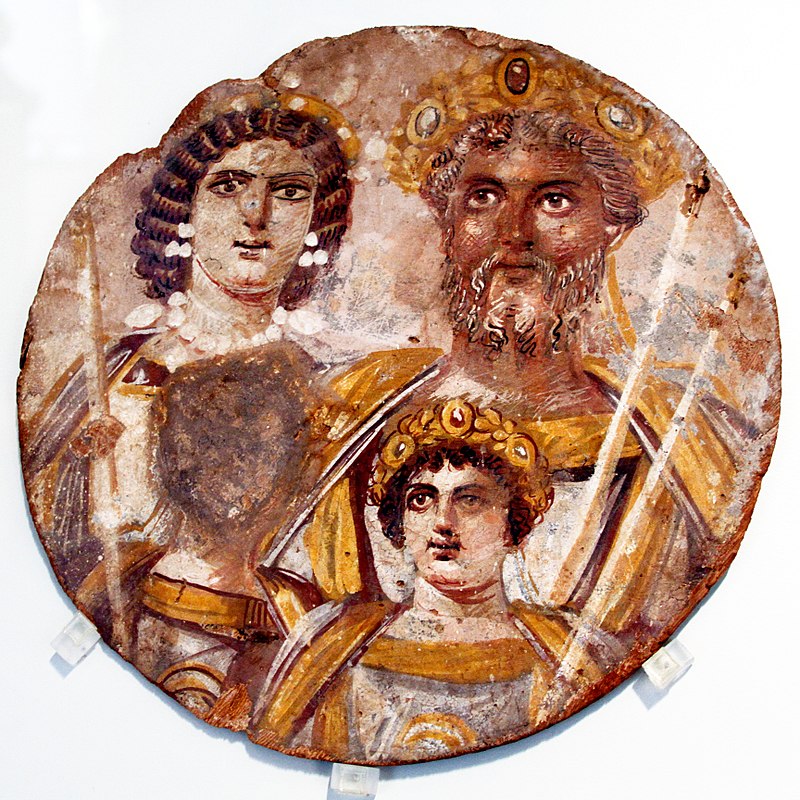
But fine. Fine. Gladiator the first was as ahistorical as they come and a smash hit too. I'm still chewing on the chalky blondness of Caracalla and Geta, though. Because: their father (Septimius Severus) was African. Their mother (Julia Domna) was Syrian. And before you use the "African Romans could be entirely descended from the whitest of white Italians" argument, we actually have a painting of Septimius Severus and his family (little Geta's face is scratched out because brother Caracalla did the thing he did and then declared damnatio memoriae):


https://upload.wikimedia.org/wikipedia/commons/thumb/0/08/Portrait_of_family_of_Septimius_Severus_-_Altes_Museum_-_Berlin_-_Germany_2017.jpg/800px-Portrait_of_family_of_Septimius_Severus_-_Altes_Museum_-_Berlin_-_Germany_2017.jpg


So, Septimius Severus: not white. His sons: not chalky blond boys. Now, it's not that the trailer doesn't show a person of colour as well - but as far as I can tell, it's another fictional character played by Denzel Washington. Definitely not Septimius Severus, if he wants to bring the Empire down.)o Wait, hang on: googling tells me he's playing "Macrinus". What? THAT Macrinus? Okay, that one was from Mauretania. Okay, carry on. But still: why the Joffrey Baratheon look for the boys who definitely did not have it? At first I thought, the logic escapes me, and then I thought, maybe it's precisely because Caracalla and Geta aren't (either in history, nor, it seems, in this movie) meant to be sympathetic characters, so the production team didn't want to cast people of color for them?

Which might actually also explain why no one tackled the Severans yet in film or tv, full stop, despite them being Rome's first non-European Imperial dynasty. (Not non-Italian - the Spaniards via Trajan and Hadrian got there first.) . They can easily compete in sheer melodrama and twists with any other dynasty (and as Emma Southon has pointed out should be called the other Julians anyway, given that except for Septimiius Severus himself and Caracalla the psycho, it's three ladies called Julia who call the shots and build up and depose Emperors), there are assassinations galore, female power brokers, incest accusations, too, and one of them may or may not have been binary - but role models, they're not. The only nice one is the kid at the end of the dynasty, Severus Alexander, and he dies for prefering negotiations over battles, so where's the moral in that?

I'm not just mocking. After the success of I, Claudius, the BBC tried repeatedly to follow it up with another historical tv show focused on ruthless powerful families. Their take on the Borgias must have been so bad no one even bothered to bash it, and then they went for the Ptolemies in the tv show The Cleopatras, which going by reviews apart from suffering from bad 80s music also had a believability problem despite its outrages (all the royal incest combinations and familiy murders) all being authentic.... and without having seen either show, just based on reading about them, I think I know what the problem was. The writers didn't bother with sympathetic characters. I, Claudius has some of the best villains in tv history with its Livia and Caligula, and even the minor villains like Sejanus are highly memorable, but the whole thing wouldn't work if the show hadn't made its narrator Claudius a sympathetic character who gets an "eternally underestimated and abused underdog makes it to the top" story. (And there's a reason why once he's actually Emperor the story wanders into some difficulties.) And there are some other non-evil characters besides Claudius getting screentime, too. Flamboyant and clever villains are always a treat, but if there's no non-evil character having non-monstrous emotions in sight, you have a narrative problem.

Now, there's no reason why you couldn't still tell the story of the Severans; aside from the Hiistoria Augusta slandering her, Julia Domna has a good press as a patron of the arts and Septimus Severus' partner in power, and Julia Maesa who doesn't is admitted to have been highly effective, organizing an impossible comeback and creating not one but two Emperors, clearly seeing the first one she installed does not work out despite him being her grandson. It should be possible to write these ladies in a multi dimensional way. Or you could add a fictional character, maybe a friend of the Julias from Syria who comes to Rome when they do and gets increasingly appalled when they watch th "all power corrupts" principle at work. But there's no happy ending in store unless you go completely Quentin Tarantino in terms of historical endings, and maybe producers figure that "The first African-Syrian dynasty ruling Rome: just as messed up as all the others" isn't what people want to see?
selenak: (Livia by Pixelbee)
Briefly, impressions from two Christmas presents I received (from [personal profile] cahn and [personal profile] kathyh, respectively.)

Emma Southon: A History of the Roman Empire in 21 Women. Immensely entertaining and informative, as is her wont. Starts with Hersilia, the wife of Romulus, and ends with the Empress Galla Placidia, but not all the women hail from Rome's social elite (though of course you have a source problem here with the 99% surviving ancient writers male and from an aristocratic background), and I was delighted to hear about some new-to-me women like Hispala Faccenia (prostitiute 186 BCE), Sulpicia Lepidinia and her friend Claudia Severa (some of whose letters to each other survive, the only examples of a (non-fictional) woman writing to another woman to make it to us, or Turia, whom we know of because her husband erected a memorial with an epitaph detailing her life and deeds. Some other women I had heard of before but only in fiction, to getting factional background (as much of it as is known) was great - Julia Balbilla the poet. (Who shows up in the audio series Caesar! in the Hadrian episode as a counterpart and foil to Suetonius, that's how I had encountered her before.) One of the most interesting chapters because of how Southon chose to tell the story was the one titled "Cartimandua and Boudicca", because Southon compares and contrasts Boudicca with Cartimandua, who was a long term client queen to the Romans, without using this as a put down of one of them but to show two different possibilities for a woman to exert power with the Roman beheemoth breathing down your neck. The book also includes early Christians like Perpetua and does provide a sense of changing times and changing ideas of self. Including the question of what it means to be Roman, as the later examples all come from different parts of the Empire, not from Rome (the city) or even Italy itself.


Elodie Harper: The W'olf Den. I hear it's the first of a trilogy, but it works as a self-contained novel for me as well. The title is of course the literal translation of the Latin word for brothel, the Lupanar, and our heroine, Amara (not her original name), is one of several women working in a Pompej brothel whom we follow through the story. I was impressed by how Elodie Harper on the one hand didn't sugarcoat what this means for the women (and doesn't let Amara be the one prostitute who for magic plot reasons never has to have to have sex with multiple clients a day, either) yet on the other hand doesn't make the novel feel grimdark and exploitative, either. The main narrative emphasis is on the relationships the women have with each other - and while there's rivalry as well as friendship, in the end the comradery is stronger than anything else - and they all have different personalities instead of being types and respond to the various events accordingly. Even one of the unquestioned villains of the story, the brothel owner Felix, comes across as three dimensional, as Harper accomplishes the tricky balance between giving him his own traumatic backstory (abused child slave) without letting this lesson his responsibility for the control issues and cruelty he shows as an adult man. Another key ingredient of what makes the novel avoid feeling grimdark is that Amara keeps having hopes and plans for a future, no matter how harsh things get, and in the end, the narrative rewards her for this.

I recognized some of the names among the Pompeians, but since we only know these names from graffiti and other archaelogical evidence, they might as well have been OCs. The one historical celebrity who shows up is Pliny the Elder, with a characterisation that reminds me of Jo Graham's theory of Sir William Hamilton (the one of triangle with Nelson and Emma fame) being his 18th century reincarnation. Which means that you can fret and hope for all of the main characters without knowing what the author has in store. (Though given the locatoin, I expect the volcano will erupt in some future novel.)
selenak: (Livia by Pixelbee)
If this year's Yuletide stories written by yours truly had a theme, it was "comedy with dark undertones". I had originally planned something else as my main gift to write, but then firstly a lot of real life stuff happened, and secondly I wanted to cheer myself up while writing, so I continued my quest to throw the most unlikely outrageous tropes at Frederick the Great. This time, it was babysitting comedy. Not involving an actual baby, but his ten years old brother, whom no one tries to eata, but it was still an eerie feeling to watch this year's Doctor Who Christmas Special and see that RTD had gone for babysitting comedy tropes as well. With my thing for messy family relationships in general and siblings relationships in particular, I always enjoy writing Frederick and the brother who was way too much like him for them to get on, and Frederick with my favourite of his long term boyfriends, Fredersdorf.


The Sitter (5885 words) by Selena
Chapters: 1/1
Fandom: 18th Century CE RPF, 18th Century CE Frederician RPF
Rating: Teen And Up Audiences
Warnings: No Archive Warnings Apply
Relationships: Friedrich II von Preußen | Frederick the Great & Friedrich Heinrich Ludwig von Preußen (1726-1802), Michael Gabriel Fredersdorf/Friedrich II von Preußen | Frederick the Great
Characters: Friedrich II von Preußen | Frederick the Great, Friedrich Heinrich Ludwig von Preußen | Henry of Prussia (1726-1802), Michael Gabriel Fredersdorf
Additional Tags: Siblings, Dysfunctional Family, Slice of Life, Queering The Tide, Family, Humor, Established Relationship, Yuletide 2023, Yuletide
Summary:

Tragedy is behind him, glory ahead: Crown Prince Friedrich of Prussia is about to enjoy the best years of his life. At least that's what he thinks when fate inflicts what might be his harshest trial: having to take care of his brat of a younger brother...


Otoh, this story is another example of my tendency to get drawn into a fandom and emerge being primarily interest in not the juggernaut pairing and/or the characters the friend who tried to get me interested in. Not that the Third Century Crisis followed by the Tetrarchy in the late Roman Empire is a megafandom, and thus does not have a juggernaut pairing. But if there was one, it surely would have been the Emperors Diocletian/Maximian, who are the guys [personal profile] mildred_of_midgard wants to hear/read about. But while I do find them interesting, I am even more interested in the women around them - and one woman who started out really low on the social scale but ended up not just on top but surviving the various changes in power which had much of the remaining cast drop off like flies was Helena. Yes, the mother of Constatine (the Great). No, she wasn't a British princess. Why not more people fictionalizing her used her actual origins as a barmaid which are way more interesting at least from the 20th century onwards is a mystery to me, but hey: all the more fun to write about her for me, and to provide her perspective on the late Roman Game of Thrones:


Invicta (4566 words) by Selena
Chapters: 1/1
Fandom: 3rd Century CE RPF
Rating: Teen And Up Audiences
Warnings: No Archive Warnings Apply
Relationships: Helena (Mother of Constantine)/Constantius, Helena (Mother of Constantine) & Diocletian, Emperor Diocletian/Emperor Maximian, Diocletian & Maximian & Constantius
Characters: Helena (Mother of Constantine), Gaius Aurelius Valerius Diocletianus | Emperor Diocletian, Flavius Valerius Constantius "Chlorus" | Emperor Constantius I., Marcus Aurelius Valerius Maximianus | Emperor Maximian, Constantine the Great (d. 337 CE), Aurelia Prisca (d. 315 CE)
Additional Tags: POV Female Character, Game of Thrones-esque, Yuletide Treat, Yuletide, Yuletide 2023, Origin Story
Summary:

Tell me if you’ve heard this one before: three future Emperors walk into a bar. The one who’s going to end up with the Empire is the barmaid.


Or: Helena, history has its eyes on you....

selenak: (Gaal Dornick - Foundation)
Emerging dazedly with my first bunch of reccommendations:.


Roman History

Something Familiar, Something Peculiar, Something for Everyone: Julia, the daughter of Caesar Augustus, has just learned that her father plans to marry her off to his best friend, Marcus Vipsanius Agrippa. She is unexcited by this prospect. Agrippa convinces her of the potential mutual advantages of this alliance.

(I've always had a soft spot for these two separately and together, and written about them myself, so it was lovely read this different and delightful take on Agrippa convincing Julia they can actually be a good match.

The Last Unicorn:

An Autumn Dirge: And so the unicorn left her forest for the second time.

(Heartbreakingly beautiful and poetic at the same time. Just like the original.)


Matthew Shardlake Mysteries

De Humani Nexus Fabrica (On the Fabric of Human Connection): A collection of short pieces in a variety of genres about Guy, Matthew, and their friendship.

Guy Malton is probably my favourite supporting character in this series of books, and the relationsohip beween him and the novels' hero, Matthew Shardlake, one of my favourite elements. I loved this layered take on them.

Sweeney Todd

Walking with a Ghost Johanna goes to see her father's grave.

(Johanna is one of the few characters still standing at the end of Sondheim's musical, and she has had an incredibly messed up life so far. This story gives her the chance to learn the truth about her parents and (start) to come to terms with what has happened.)

Willow (tv)

I liked this short lived tv series, cancelled after only one season. For me, it had great charm and a similar mixture of humor and heart than the movie had. So I was delighted to see all the fanfic this Yuletide:

Pierced through the heart (but never killed): Thraxus Boorman grows up.

(In which we find out his backstory, how his connection with Madmartigan happened, and it's a fun growing up tale with a heartbreaking ending.)

Making Magic: They could do with another wizard. Elora thinks Bavmorda's granddaughter would be perfect but Kit disagrees.

(The way the series wrote both Elora and Kit against expectations, reversing tropes, as it were, was great, and their relationship one of the most interesting in the tv show to me. This story is a good illustration of why.)

Wheel of Time (tv)

The Truth You Think You Hear: Nynaeve manages to channel when Liandrin leaves them with the Seanchan, and her weave interacts unexpectedly with the Waygate.

(Liandrin is a character who on paper could have been one dimensional but who, especially in the second season, as played by Kate Fleetwood is absolutely fascinating. So was the way she sparked off Nynaeve on the show, and here in this story.)
selenak: (Livia by Pixelbee)
Started but won't finish: the latest miniseries take Great Expectations, starring Olivia Colman as Miss Havisham. It's one of those productions which in theory sound good - colourblind cast, scriptwriter coming from successful original show (Steven Knight) - and in practice is just a mess. Also one that's mostly filmed in grey, both the marshes that form the landscape of the early episodes and London (the end of the first London based episode is where I stopped). Estella's dresses are sometimes the only dots of colour.

Great Expectations: The G.R.R. Martin Version ) See, Dickens is anything but subtle with his own moral lessons, but he knew how to interweave them with compelling characters and a good yarn. Removing the vitality of the characters in favour of "here are the evils of 19th century British society in human form" in overdrive does this adaption no favours, and there's only to much leisure time I have, so, goodbye, tv series (despite Colman being excellent as the creepiest, most predatory of all Havishams).

Whereas what I go through at quick pace because it's compellingly, emphatically and wittily told while being no less critical of the society it describes (and ours): A Fatal Thing Happened on the Way to the Forum, by Emma Southon. As with Southon's biography of Agrippina the Younger, I consumed it in audio form, not least because that struck me as eminently suited to her style of writing, which is very conversational . This book basically uses murder in its many many aspects as a read thread through several centuries of Roman history (from the 2nd century BC to the end of the Antonine period, to be precise - Southon stops before the Third Century Crisis) to provide us with a social history of Rome. Individual chapters: "Murder on the Senate Floor", "Murder in Roman Law", "Murder in the Family", "Murder in Marriage", "Murder in the Slave State", "Murder by Magic", "Murder in the Imperial House", "Murdering an Emperor", "Judicial Murder". Behind those chapter titles hides a clever, somewhat surprising and incredibly effective structure, as Southon starts her book with the most prominent asassination (Caesar), then goes back to the Gracchi, and forward again, instead of building up to it. The reason why this is effective is because it's not actually the prominent murders among the elite that lie at the heart of the book, but the wives getting killed by their husbands who weren't part of a ruling family, the every day violence against slaves on whose backs the entire system was built, and the gruesome executions (be they in the arena or by cruxifiction) that remind one all over again what inspired Collins' Hunger Games.

(Of course, the written sources mostly were written by and focused on the Senatorial class, but for example tombstones manage to provide glimpses of other stories, like the couple of Imperial slaves who managed to get permission to have a tombstone for their infant baby son, or the freedman mourning his wife who like him started out as a slave.)

The big difference to the Dickens adaption cited above is that while Southon is no less dedicated to exposing the baked in injustices (seedy underbelly would be the wrong term, really, because there was nothing hidden about, not least because it wouldn't have occured to the Romans there was something to hide) of the Roman society, she does so while keeping everyone human, and sketches out the legal and belief systems for context really well. The generally flippant narrative tone comes with deep empathy that manages to keep it real that everyone killed was a person in their own right with a story and feelings, not a moral lesson or a joke.

Now, some of her takes I could argue with. (I mean, I agree that whether you're categorized as a good or a bad Emperor by historians who were senators definitely had to do with whether you managed to provide the Senators of your own time with the illusion that you cared about their opinion, or rubbed their noses into the fact they had no real power, but I wouldn't have chosen Caligula vs Hadrian to illustrate that point, because Hadrian, while counted among the Five Good Emperors by tradition, was very much disliked by the Senate of his time and had a very mixed press among historians.) And there's one big glaring mistake early on - Cicero didn't execute Catiline without a trial, he did this with several of Catiline's followers. Catiline himself died in battle against the forces led by Cicero's fellow consul Antonius Hybrida. (See also Sallustius for describing his last stand.) And Emma Southon doesn't just make this mistake once, she's referencing it two or three times. (Because these executions without a trial came back to bite Cicero big time, and played their part in the continuing decline of the Republic. But, again, Catiline himself wasn't among the executed.) (After this mistake, I wondered whether there might be others I missed, but as far as I could tell, no.)

None of these nitpicks take away from how immensely readable (listenable?), enjoyable and moving I found this book, though. And she may have swayed me on a couple of topics. (The question as to whether or not Livia arranged anyone's death, to be precise.) Plus, I really need to get around to reading Apuleius one of those days.
selenak: (Romans by Kathyh)
Having gotten the taste of historical podcasts, I checked out some Roman ones. I started with “History of Rome” by Mike Duncan, simply because I’d read his Lafayette biography and listened into his “Revolutions” podcast, but while “History of Rome” is okay, I like Emperors of Rome, an Australian podcast, much better. Despite the title, which I suspect came to be because Duncan got there first, this podcast isn’t just about the Emperors, it has several extensive miniseries about the Republic as well, and within the Empire devotes a lot of listening time to the women, too, not to mention episodes on slavery, sex, Roman law, witches, and of course the various “antagonists” of Rome over the centuries. (With the occasional episode about famous historical fiction, like the movie “Spartacus”, or “I, Claudius”.) But the icing of the cake is the format, because it’s in dialogue, with the host Mike Smith interviewing various historians about the subject du jour, mainly but not exclusively Dr. Rhiannon Evans and Dr. Caillan Davenport. I was also very pleased that Agrippina (the Younger) got two episodes, with Emma Southon, whose Agrippina biography I liked a lot, as the interview partner.


(Don’t get me wrong: Duncan is a good narrator, which is why I listened through most of his “Revolutions” podcast already. But maybe because I know a bit more about Roman history than, say, about the Mexican Revolution, the interview format of “Emperors of Rome” works better for me. Also: this podcast is really good in balancing the awareness of source bias - and pointing out who wrote what and with which distance to the era under debate - and interesting storytelling.)


Anyway, dipping in and out of centuries of Roman history reminded me again and in some cases filled in details I did not yet know about the absolute insanity of the Third Century Crisis, when you had 25 Emperors in ca. 50 years because no sooner did one guy elevated by his troops in one corner of the Empire did the next crisis and backstabbing knife wait in the other. Also, years ago someone commented on my journal there should be a Death of Stalin like black comedy about the year of the Five Emperors, and I could so see that. In fact, I also want a "Death of Stalin" like miniseries for the entire Severan Dynasty, which, as Emma Southon points out on the podcast, should really be called the second Julian dynasty, given the three most important people in it making it a dynasty rather than a one off event were Julia Domna, Julia Maesa and Julia Mamaea.

Mind you, that family feels like someone in current days has made a wish for a Roman dynasty started by Rome's first African Emperor and Syrian Empress, with (three) powerful female characters who get to actually govern and don't get their power taken away again a la Agrippina, and got then got massively monkeypawed. All this happens, but Julia Domna has to live through getting one of her sons murdered in her arms by the other one and years later either starves herself to death or gets starved to death, Julia Soaemias gets murdered together with her son (Elagabal), Julia Mamaea gets murdered with her son (Severus Alexander) - the only one who dies on top, of natural causes and when the family prospects are looking good is Julia Maesa, Julia Domna's sister who organized the family comeback and got immortalized as "grandmother of Emperors" for her trouble - , and even if you write off some of the more gruesome tales about Caracalla and Elagabal to hostile senatorial historians, what remains is still pretty ghastly. Caracalla was the one who murdered brother Geta in Julia Domna's arms, forbade her to mourn for him but then let her do most of the administrative governing, since he was mostly into the military stuff (which he wasn't actually good at, but he loved hanging out with the troops and since he paid them more than any previous Emperor, he was very very popular there) when he wasn't organizing massacres among civilians for mocking him. Elagabal made Nero look like a wonder of self discipline and moderation, with the result that grandma Julia Maesa could see which way the wind was blowing, made him adopt his cousin Severus Alexander and washed her hands of him and her daughter Julia Soaemias whereupon they were gruesomely murdered, but the dynasty continued with little Severus Alexander as Emperor and Julia Maesa and Mulia Mamaea ruling for him. Basically, the only way I can see that story told and not come across as GrimDarkOverdrive is in a black comedy way.

Lastly: Rhiannon Evans is a Doctor Who watcher who when discussing slavery points out something about the Fires of Pompeii I don't think I ever consciously noticed, despite having rewatched the episode at least three times (it's a favourite). She likes it, too, but as she correctly says, it's noticable that one one owns a slave there, especially not the nice family with whom the Doctor and Donna are staying, when in in reality even lower income Roman households (i.e. not the super rich) had at least one or two, and that family seems to be at the very least well off, and presumably a likely reason for this is that the Doctor otherwise would have had something to say on the subject and/or the familly could have come across as less sympathetic. Which reminded me again that it's rare for historical fiction set in ancient Rome (or Greece, or any of the slave-owning societies of the ancient world, which is de facto all of them) which doesn't have slavery at its narrative center (i.e. any take on the Spartacus story) to do something with the fact slavery is or should be so ever present in your setting. I mean, a series like Rome has two narratively important supporting slave characters (Posca and Eirene), who both end up freed, but they're not pov characters, and the rest of the slaves depicted fall under the "silent and supportive of their masters" category (like Servilia's female slave in whose arms she dies). Though Rome makes no bones about everyone owning slaves and doesn't try to present the main characters as enlightened about this. (Vorenus like a typical Roman soldier got his share of Gallic captives to sell as slaves and when a good many of them haven't survived the journey is put out of this because he was counting on the money for his family, not because they deserve to live like he does. When Pullo kills Eirene's fellow slave and boyfriend, the other characters take offense that he does so with a slave who isn't his property, and in Vorenus' household, not because they see this as murder.)

Though when slavery is a narrative focus - again, as in any take on the Spartacus story - , there's the avoidance of something else. I mean, it's been years since I've watched the trashy-yet-compelling tv series Spartacus, but as far as I recall, while you had one or two freeborn Romans per season who weren't villainous but came to see the horror and side with the slaves, what the tv show avoided nearly altogether was the existence of freedmen. (And -women.) I say "nearly", beause there's Gannicus, of course, but he's presented as a big exception. Whereas the fact that getting freed by your master or saving enough money to free yourself was a realistic possibility (if you weren't a slave in the mines, that is, because if you worked in the mines, you didn't live long enough) is probably a factor in there not having been more (and more wide spread) slave uprisings; it was enough of a carrot to make the awful stick more endurable for more people, I suppose. Plus, of course, the social mobility was there in a way it wasn't in more modern versions of slavery (i.e. especially but not solely the 19th century US); every senate-rank historian might complain about Claudius' freedmen Pallas and Narcissus, but the fact of the matter is that they were the most powerful men in his administration, then you have Antonia Caenis, freedwoman of Claudius' mother Antonia and live long companion of the later Emperor Vespasian, and a few generataions later, one of the Five Emperors in the year of the Five Emperors (following the much deserved assassination of Commodus), Pertinax, was the son of a freedman. None of this makes slavery a better or less dehumanized state to be in, don't get me wrong, but when you look at just how many slaves there were around in Roman society, how much said society depended on their labor, and wonder why Spartacus' was the last and greatest of slave uprisings instead of slave revolts being a near constant state of affairs, that hope you could end up free with your own property and family and with your children having the chance to achieve high office, eventually the highest, was probably a factor.

P.S. Speaking of Pertinax, getting into the Decline and Fall narrative and the Year of the Five Emperors business again made me realize where Lindsey Davis (in her Falco series) got several of her Roman names from - another of the Five was Didius (Julianus), after all.
selenak: (Peter Pan by Ravenlullaby)
I woke up to very sad news - Ray Stevenson has died, at only 58 years of age, after a sudden illness mid shooting, according to the articles. He's never disappointed in anything I've seen him in (my Blackbeard in Black Sails problem is a me problem, not a Stevenson problem), but the role which immediately still comes to mind when I think of the name "Ray Stevenson" is Titus Pullo in the tv series Rome, where he could exude terrifiying brutality and incredible human warmth, and you believed both that this is a man who'd do some spoilerly for Rome The Series stuff ). So ave atque vale, Ray Stevenson. Thirteen!


Away from rl and into fantasy: I watched Peter Pan & Wendy, the latest effort by the Mouse on the tale. Oh dear. Spoilers think Disney should just stay away from anything Pan for the next half century. )
selenak: (Antinous)
Catherine, Called Birdy: Charming film based on a YA novel I have not read, starring a familiar supporting cast, including Billie Piper as our heroine's mother and Andrew Scott as her mostly-useless-but-redeems-himself-late-in-the-day father, and Lesley Sharpe as her nurse. It''s a "days in the life of a medieval girl" kind of story with cheerfully anachronoistic music but surprisingly well done clothing that lives from its teenage first person narrator's brash charm. Early on, my inner nitpicker quibbled that of Birdy's father is in financial trouble, wouldn't he want to marry his sons to rich brides instead of trying to marry his daughter whom he has to provide a dowry for, but hey, this is not a film pretending at historical realism anyway (which ironically might have allowed it NOT to go for the ultra brown Rembrandt look of medieval tv shows and movies that's so in fashion and instead go for actual colours, yay!), and so I shut that voice up anyway. (As it's not pretending at seriousness, I also was reasonably certain Birdy aka Catherine would not have to put up with the marriage to a gross middle aged man, which is not what you want from this kind of story.) It does the usual growing-up-story tropes ( rebelliousness against and tricking smug or overbearing adults, fallout and reconciliation with best friend(s), getting confronted with actions as seen by others at crucial point, falling of pedestals, reevaluating others, etc.) and does them very enjoyably.

Memoirs of Hadrian by Marguerite Yourcenar. This is one of those classics I've tried as a teenager, abandoned, and meant to try again years later but never did, until now. I think what threw me back in the day, and to a degree still throws me, is the comparison to I, Claudius, with both named not just as fictional memoirs of Roman Emperors but fiction that became so popular it still to a large degree influences how people think of the Emperor(s) in question, despite being fiction. On that basis, it's true, but the novels are completely different. I'm not talking about accuracy on either author's part. They both did their homework, to put it flippantly (ironically, Graves' book is mostly based on Suetonius, Hadrian's secretary who got fired), and they both still very much used the material they had to do their own thing with it. But Graves' novel - or novels, if you count "Claudius the God" as a separate one instead of as part II split for publication reasons - while certainly drawing a strong portrait of its narrator is more of a (wildly entertaining) multi generation family soap opera than concerned solely with the fictional memoirist who tells it. (The legendary tv adaption strengthens those traits and chucks out more literary bits like Claudius interviewing historians Asinius Pollio and Livy for their impressions of Julius Caesar, but those traits are there in the book already.) As a result, there are plenty of other memorable characters around: Livia and Caligula as athe main villains, of course, but also, say, Claudius' mother Antonia (with an iron clad integrity but no sympathy for her handicaped son), or Tiberius, or Claudius' friend Herod Agrippa.

The Memoirs of Hadrian, otoh, is strictly about Hadrian and no one else. The only other person whom you get an idea about as a character is his lover Antinous, and even there you have to put a question mark. (More about this later.) Everyone else, no matter whether our narrator likes them - lilke his patroness and Trajan's wife Plotina, whom he largely owes his throne to and basically sees as a twin soul - or dislikes them (his own wife, his brother-in-law) remain paper thin and never come alive. According to Yourcenar's appendix, this is a deliberate choice, as "Hadrian himself does not see them" as deeper than that. (At a different point in the appendix, she also says that writing a woman's memoirs, like, say, Plotina's, would be iimpossible, because a woman would not tell her story, lest she stops being a woman. Presumably she means a Roman woman, but you know, Agrippina the Younger (sister of Caligula, wife of Claudius, mother of Nero) actually did write her memoirs, though they are lost now.) Fine, but to this reader, it makes the book a lesser novel, its reputation as the ultimate masterpiece in historical fiction not withstanding. I want memorable characters in my fiction, historical or otherwise, more than one.

More details about the Memoirs of Hadrian and history to follow )
selenak: (Romans by Kathyh)
This is a little frivolity I wrote to amuse [personal profile] mildred_of_midgard, who'd wished for someone to write her Diocletian & or / Maximian for several Yuletides in a row. Last year, I actually caught up with the late Roman Empire somewhat, and when I discovered the insane family soap that went with Mildred's Competant Autocrat/Loyal if disgruntled Sidekick saga, well:

Something's Gotta Give (3514 words) by Selena
Chapters: 1/1
Fandom: 3rd Century CE RPF, Roman Emperors 3rd Century CE RPF
Rating: Teen And Up Audiences
Warnings: No Archive Warnings Apply
Relationships: Emperor Diocletian/Emperor Maximian, Gaius Aurelius Valerius Diocletianus | Diocletian/Gaius Galerius Valerius Maximianus | Galerius
Characters: Gaius Aurelius Valerius Diocletianus | Emperor Diocletian, Marcus Aurelius Valerius Maximianus| Emperor Maximinian, Gaius Galerius Valerius Maximianus | Emperor Galerius, Constantine the Great (d. 337 CE), Marcus Aurelius Valerius Maxentius | Emperor Maxentius, Flavia Maximiana Theodora, Flavia Maxima Fausta Augusta, Galeria Valeria, Flavius Valerius Severus | Emperor Severus II.
Additional Tags: Alternate Universe - Modern Setting, Alternate Universe - Corporate, Alternate Universe - Crack, Yuletide Treat, Yuletide 2022, Yuletide
Summary:

Subject: Re: 20th Anniversary – and more
From: Herculius@tetrarchy.com
To: Jovius@tetrarchy.com:
Diocletian,
You want me to do what?????


When Senior CEO Diocletian decides to retire, he imagines his succession has been arranged. He couldn't be more wrong...

selenak: (Default)
A first crop of Yuletide stories I loved:

Historical Fiction:

And flies with Swallow's Wings: Scenes from a London cookshop. This is a great take on one of the more intriguing anecdotes re: Anne Neville and Richard III, and to say more would spoil the story.

Periapsides: Five things Catherine of Aragon and Anne Boleyn could have been to each other.

An action for reclaiming an inheritance: in which Terentia hires a lawyer, young Cicero, to represent her in a lawsuit, and I absolutely adore this take on her - and everyone else who shows up in this tale set in the last years of Sulla's reign.

Andor:

All Blue and Gold and Glittering:
In search of a present for Mon Mothma, Tay Kolma pays a visit to an antiques shop he’s been told she’s fond of.

There is a World beyond this Place: Twelve things Cassian Andor misses most in prison.

The Body/Stand By Me:

Summer in the City In the summer of 1964, Chris gets Gordie to come with him on a different kind of adventure.

A Christmas Carol:

The Price of Salvation: The fate of his old partner who after all saved Scrooge is not something Scrooge just accepts. Especially since the ghost of Jacob Marley keeps coming back...


The Expanse:

A Fresh Start: in which Drummer and Avasarala learn to deal with each other.

Ten Lullabies: great ensemble portrait through the theme of lullabies.

Slash Recs

Aug. 3rd, 2020 07:22 pm
selenak: (Romans by Kathyh)
I'm on the road for the remaining week, with limited online access, so I'm getting my recs out quickly. Here are four of my favourites from the Rare Male Slash Exchange:


The Exorcist (TV)

That's how the light gets in: Excellent hurt/comfort set during the road trip between seasons 1 and 2.

The Mandalorian

Diversion: Din/Kuiil was not a pairing I'd have thought of, but the writer of this lovely vignette sold me on it.

Rome:

War Stories: Caesar/Mark Antony, and wonderfully IC for these versions of them, too.


Star Wars

Undercover Lover: To quote the summary: Chancellor Palpatine wants a Jedi bodyguard. Jedi Master Mace Windu wants to keep an eye on a dangerous, corrupt politician. Clearly, this is a match made in heaven. Hilarity ensues, and I will never unsee the possibility now. Clearly, this would have saved the galaxy far, far away. :)
selenak: (Cleopatra winks by Ever_Maedhros)
Martin Scorsese and Michael Hirst want to do a tv show called THE CAESARS, about the early rulers of ancient Rome.

I, Claudius who? Rome what? Well, okay, fine, it never stopped anyone in entertainment that there are earlier versions. And given how uninspired the first half of the latest Vikings season came across to me (which is why I haven't reviewed in these very pages, gentle reader), I'm not surprised Hirst is ready to move on. Allow me some amusement, though:

He says his dramas are not documentaries but the details are rooted in history: “Just like Shakespeare’s history plays, they only start with some historical facts, then the drama takes over. You can’t have both.”

Hirst, you're not Shakespare. (Not that he's more accurate, I'll grant you.) Your shows are at their best entertaining schlock with some compelling characters. Stand by it.

Also:

The Caesars aims to give a new insight into the young Julius Caesar: “In the movies he’s usually a middle-aged guy, struggling with political complexities. But he was fantastically interesting and ambitious when he was younger.

Because clearly, a middle aged guy struggling with political complexities is dull. (So much for you, Londo Mollari, character of characters of my heart.) Btw, the idea that Caesar grew less ambitious as he grew older would amuse everyone in Rome to no end. (Or not, depending on their political pov. And state of survival.) This said, Caesar's younger years are less covered. Basically, here are young Gaius Julius Caesars I recall from the last decades:

1) The one from Xena, played by Karl Urban. Spoiler: he's a villain.
2) The one from Spartacus: War of the Damned, where he's one of main antagonist Crassus' two sidekicks. Spoiler: he's a villain.
3) The one from Colleen McCulloughs Masters of Rome book series, volume 3, Fortunes' Favourites. Meant to be a hero, but alas, she commits the dreadful mistake of Gary Stuing him into boringness, here and in subsequent volumes. (Which is why I like the first two volumes with Marius and Sulla as main characters so much better. She didn't make that mistake with those two.) (Err, Caesar is around for many more books in that series, of course, but we're talking about young Caesar specifically.
4) The one from Waltraud Lewin's YA novel about young Servilia, written in German and so my knowledge not translated into English. For my money the most interesting of the lot, though she takes some liberties as in: young Servilia and Caesar already meet when Sulla rules, Servilia just got married to Brutus and Caesar is on the run. It's a coming of age novel about Servilia, and young C. is both charming and ambigious, more of a trickster character. Also prone to fall sick with Malaria at the worst moment.

Basically, there's room for Hirst to deliver his own version to pop culture, and he's bound to use both the on-the-run-from-Sulla episode and the interlude with the pirates, but what I really want to know is whether or not he'll use the King of Bithynia as boyfriend, and not, as Colleen McCullough in her Gary Stu tale did, as a paternal friend. More Hirst talk:

A lot of the Caesars came to power when they were young, and we’ve never really seen that on screen. It’s the energy, the vitality, the excess of a young culture that’s being driven by young people.

Um, what? Octavian/Augustus was young when coming to power, granted, but Tiberius was OLD. (Part of the problem. By the time he'd finally made it to the throne, he was too bitter not to take that out on people.) Caligula was young again, whereas Uncle Claudius was old. And then Nero rounds it off with another young Caesar as the last of the Julian-Claudian dynasty. That makes three young power reachers versus three old ones (if you count Caesar himself, who most definitely was NOT young when making it to true power in Rome.

Mind you, in the most recent season of Vikings, Hirst presents an adult Alfred (who has thus the bad luck to compete with the one from The Last Kingdom, and well, that's a tough job to live up to) who gets on the throne in a decidedly ahistorical way and at an ahistorical point in his life, so I wouldn't put it beyond him to shorten the reign of Augustus so Tiberius isn't that old and sour and keeping Claudius magically young. (I mean, Lagertha looks unchanged since season 1, which means the actor playing her son Björn now looks older than she does.) And of course, this is the producer/writer who cast Jonathan Rhys Meyer as Henry VIII and kept him from gaining weight and grey hair until the very last episodes of the last season of The Tudors. What confounds me is that that Hirsts older characters are more often than not his most interesting ones. His Cardinal Wolsey was the only one I was interested in in the first season of The Tudors. To give credit where due, Hirst was the only one who really used Chapuys the Imperial Ambassador as key supporting character through the entire show, and Chapuys isn't a youngster, either, at any point. As for Vikings, Siggy was my favourite for the first two seasons (alas), and never mind Ragnar, Ekbert was the magnificent bastard for me, as played by Linus Roache and thus no spring chicken, either.

Another thing: no one would ever dispute Martin Scorsese's cinematic eye, but the combination of the two definitely makes me think "male centric saga to the nth degree". And you know, not that Rome was feminist (au contraire), but Atia and Servilia were among the most memorable characters, and I, Claudius would never have had the impact it did without Livia in the first half. In conclusion: if I were you, Michael Hirst, I'd hire some female scriptwriters to work with me.

Lastly, on an unrelated note: tomorrow I'll be busy the entire day, so I won't get to watch the Star Trek: Discovery finale until the evening, if that. Pray remember the spoiler cut is your friend, oh fellow Disco admirers, and so am I!
selenak: (Emily by Lotesse)
The three stories I wrote for this year‘s Yuletide were:

1.) My Assignment:

Icebound (13024 words) by Selena
Chapters: 7/7
Fandom: Order of the Air Series - Melissa Scott & Jo Graham, 20th Century CE RPF
Rating: Teen And Up Audiences
Warnings: No Archive Warnings Apply
Relationships: Mitchell Sorley/Stasi Rostov
Characters: Mitchell Sorley, Stasi Rostov, Henry Kershaw, Leni Riefenstahl, Max Schirmer, Franz Schrieck, Hans Schneeberger
Additional Tags: Yuletide, 1930s, Adventure & Romance, Foreshadowing, Films, Antisemitism, POV Jewish Character
Summary:

Spring of 1933: Mitch and Stasi hadn't planned on spending their honeymoon dodging bears and icebergs. But the pilot supposed to do the hair raising stunt flying on the German-American movie "SOS Iceberg" has fallen sick, the leading lady may or may not be possessed, and there is a ghost bent on revenge involving the new German leader...


My recipient requested Stasi and Mitch from the Order of the Air novels by Melissa Scott and Jo Graham. Since I adore the novels, and also their characters, this was a joy to write. The reason why it‘s also tagged for 20th Century RPF is that other than Mitch, Stasi and briefly a friend of theirs, all the other characters are historical. The novels themselves, which start in the 1920s and by now have reached the later 1930s, are adventures involving flying, archaeology and supernatural elements, and they give both cameos and important roles to figures of history. My beta, who hadn‘t yet a chance to read them, told me she had no trouble following the story, which gives me the hope it‘s understandable for fans of the book and not-yet-readers of same alike.

Read more... )


2.) Treat for a friend who had a tough year the first:

Selkie Bride (10911 words) by Selena
Chapters: 5/5
Fandom: David Copperfield - Charles Dickens
Rating: Teen And Up Audiences
Warnings: No Archive Warnings Apply
Relationships: Emily Peggotty/James Steerforth, David Copperfield/James Steerforth, Emily Peggotty & Martha Endell, Emily Peggotty & Daniel Peggotty, Emily Peggotty & David Copperfield, Emily Peggotty/ Ham Peggotty
Characters: Emily Peggotty, James Steerforth, Littimer, Daniel Peggotty, Ham Peggotty, Clara Peggotty, David Copperfield, Martha Endell, Mrs. Gummidge
Additional Tags: POV Female Character, Misses Clause Challenge, Character Study, Crossdressing, Power Dynamics, Yuletide Treat, Complicated Relationships, Yuletide
Summary:

In which Emily Peggotty becomes the heroine of her own life, and the villain, too.


When I saw [personal profile] likeadeuce in her Yuletide letter had requested David Copperfield, and spefically Steerforth, David/Steerforth and had added that if Emily was to show up, she‘d want her to have her own agenda, inspiration struck. Me being me, the result is a story about Emily first and foremost, with David/Steerforth a subplot, so to speak, but years of personal aquaintance had made me reasonable certain ‚Deuce would not mind.

Emily is one one of Dickens‘ takes on that very Victorian trope, the seduced woman promptly punished by fate, though as opposed to many another Victorian fallen woman she makes it out of her novel alive and actually well. Still, it struck me upon rereading how much he keeps the adult Emily (as opposed to the child Emily) off stage, so to speak - she‘s mostly reported or talked about, and since the narrator is David who is canonically clueless about women (and a lot of men as well), this provided me with ample room for fleshing out the character. And canon gave me a lot to work with, actually. (For example: Rereading the novel, it far clearer than I had recalled that Emily really did not want to marry Ham quite independent from the Steerforth factor. Also, according to Littimer she became fluent in French, Italian and possibly German in a very quick time, which says a lot about her linguistic gifts and smarts. And while David insists on seeing her as utterly helpless, it stands to reason that a woman who can make it back from Naples to London on her own without any money to start that journey with has good surival skills.)

Providing Emily with a story of her own while still keeping with all that happens in the novel, and trying my hand at plausible Dickensian dialogue for Steerforth was a very enjoyable challenge, and I loved meeting it.


3.) Treat for a friend who had a tough year the second:

Ash and Iron (6291 words) by Selena
Chapters: 1/1
Fandom: Rome (TV 2005)
Rating: Teen And Up Audiences
Warnings: No Archive Warnings Apply
Relationships: Atia of the Julii & Servilia of the Junii, Julius Caesar/Servilia of the Junii, Atia of the Julii & Octavia of the Julii, Mark Antony/Atia of the Julii, Octavia of the Julii/Servilia of the Junii, Servilia of the Junii & Cato the Younger
Characters: Atia of the Julii, Servilia of the Junii, Octavia of the Julii, Julius Caesar, Mark Antony, Cato the Younger, Terentia (c. 98 BCE–5 CE)
Additional Tags: Backstory, Character Study, POV Female Character, Misses Clause Challenge, Yuletide Treat, Yuletide
Summary:


Atia would never concede victory to Servilia, in anything.


[personal profile] kangeiko asked for Atia and Servilia (in their Rome incarnations) in her letter. While the feud between these two ladies in central to the tv show they‘re in, it hasn‘t been covered all that much by fanfic, so I couldn‘t resist, and returned to Rome for some more fanfiction. It even gave me the chance to include one of my favourite anecdotes about the historical Servilia, as well as the fact that this anecdote and the birth of the later Augustus both happened during Cicero‘s consulate, in the year of the Catiline Conspiracy. Rewatching some of the Atia and Servilia centric episodes was an added bonus for me.

Profile

selenak: (Default)
selenak

December 2025

S M T W T F S
  1234 56
78910 11 1213
14 15 161718 1920
21 222324252627
28293031   

Most Popular Tags

Syndicate

RSS Atom

Style Credit

Page generated Dec. 24th, 2025 04:15 am
Powered by Dreamwidth Studios